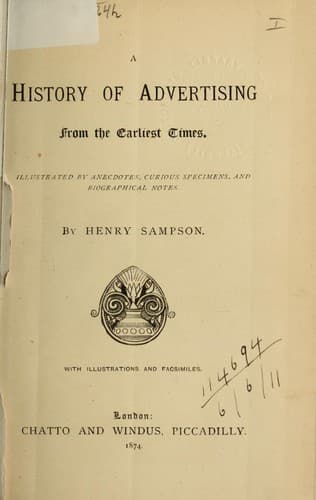
A History of Advertising from the Earliest Times.Sampson, Henry
History
A History of Advertising from the Earliest Times.
Sampson, Henry
Advertising -- History
IF any protestant dissenter desire this spring time to be furnished
with sedition seeds, or the true protestant rue, which they call “herb
of grace,” or any other hopeful plants of rebellion, let them repair
to the famous French gardeners Monsieur F. Smith, Msr. L. Curtis, and
Msr. B. Harris; where they may have not only of all the kinds which
grew in the garden of the late keepers of the liberty of England; but
much new variety raised by the art and industry of the said gardeners,
with directions in print when to sow them, and how to cultivate them
when they are raised.
You may also have there either green or pickled sallads of rumours and
reports, far more grateful to the palate, or over a glass of wine,
than your French Champignons or mushrooms, Popish Olives, or Eastland
Gherkins.
And on March 1 there was given to the world:--
A MOST ingenious monkey, who can both write, read, and speak as good
sense as his master, nursed in the kitchen of the late Commonwealth,
and when they broke up housekeeping entertained by Nol Protector, may
be seen do all his old tricks over again, for pence apiece, every
Wednesday, at his new master’s, Ben. Harris, in Cornhill.
This was a species of wit similar to that associated with the imaginary
signs adopted in books with secret imprints, in order to express certain
political notions, the sentiments of which were embodied in the work;
for instance, a pamphlet just before the outbreak of the Civil War is
called, “Vox Borealis, or a Northerne Discoverie, etc. Printed by
Margery Marprelate, amidst the Babylonians, in Thwack Coat Lane, at the
sign of the Crab Tree Cudgell, without any privilege of the Catercaps.”
One John Houghton, F.R.S., who combined the business of apothecary with
that of dealer in tea, coffee, and chocolate, in Bartholomew Lane,
commenced a paper in 1682, entitled _A Collection for the Improvement of
Husbandry and Trade_,[25] which continued to be issued weekly for some
time; and though it failed, it was revived again on March 30, 1692. It
was modelled on the same plan as the _City Mercury_ of 1675, and was
rather ambitious in its views. It consisted of one folio half-sheet, and
was intended to “lay out for a large correspondence, and for the
advantage of tenant, landlord, corn merchant, mealman, baker, brewer,
feeder of cattle, farmer, maltster, buyer and seller of coals, hop
merchant, soap merchant, tallow chandler, wood merchant, their
customers,” &c. But no advertisements proper were mentioned at first; it
was a mere bulletin or price-current of the above-named trades and of
auctions, besides shipping news and the bills of mortality. The first
advertisement appeared in the third number, it was a “book-ad,” and
figured there all by itself; and it was not till the 8th of June that
the second advertisement appeared, which assumed the following shape:--
Public-domain text, read in full here on John Shaqi.
Reviews
Reviews
No reviews yet
Be the first to share your thoughts on this work.
Elsewhere in the archive
Join the Discussion
Join the discussion
Sign in to leave a comment or review.
Sign InorCreate an account