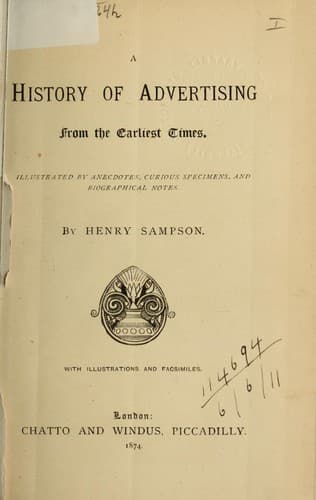
A History of Advertising from the Earliest Times.Sampson, Henry
History
A History of Advertising from the Earliest Times.
Sampson, Henry
Advertising -- History
[25] John Nicholl, in his “Literary Anecdotes,” vol. iv. p. 71, calls
the editor of this paper Benjamin Harris, a well-known publisher of
pamphlets in the reign of Charles II., and says that J. Knighton was
the editor in 1692. This last name may be a clerical error for
Houghton.
CHAPTER VI.
_DEVELOPMENT OF ADVERTISING._
We have now arrived at a period when the value of advertising was
beginning to make itself felt among even the most conservative, and when
it at last began to dawn upon the minds so unaccustomed to change or
improvement, that a new era in the history of trade was about to
commence, even if it had not commenced already. So the newspapers of the
latter half of the seventeenth century begin to offer fresh inducements
to the reader, no matter whether to the antiquarian or simply curious.
And he must be a flippant reader indeed who is not impressed by these
files of musty and bygone journals, pervaded by the spirit of a former
age, and redolent of the busy doings of men who generations ago were not
only dead but forgotten. Few things could be more suggestive of the
steady progress of Time, and the quite as steady progress of his
congeners, Death and Forgetfulness, than these papers. Novelists and
essayists have described in most eloquent words the feelings which are
aroused by the perusal of suddenly-discovered and long-forgotten
letters; and similar feelings, though of a much more extended
description, are evoked by a glance through any volume of these
moth-eaten journals. A writer of a few years back, speaking of the
advertisements, says, “As we read in the old musty files of newspapers
those _naïve_ announcements, the very hum of bygone generations seems to
rise to the ear. The chapman exhibits his quaint wares, the mountebank
capers again upon his stage, we have the living portrait of the
highwayman flying from justice, we see the old-china auctions thronged
with ladies of quality with their attendant negro-boys, or those by
‘inch of candle-light,’ forming many a Schalken-like picture of light
and shade; or later still we have Hogarthian sketches of the young
bloods who swelled of old along the Pall-Mall. We trace the moving
panorama of men and manners up to our own less demonstrative, but more
earnest times; and all these cabinet pictures are the very
daguerreotypes cast by the age which they exhibit, not done for effect,
but faithful reflections of those insignificant items of life and
things, too small, it would seem, for the generalising eye of the
historian, however necessary to clothe and fill in the dry bones of his
history.” Indeed, turning over these musty volumes of newspapers is for
the imaginative mind a pleasure equal to reading the _Tatler_ or
_Spectator_, or the plays of the period. By their means Cowper’s idea of
seeing life “through the loopholes of retreat” is realised, and
characteristic facts and landmarks of progress in the history of
Public-domain text, read in full here on John Shaqi.
Reviews
Reviews
No reviews yet
Be the first to share your thoughts on this work.
Elsewhere in the archive
Join the Discussion
Join the discussion
Sign in to leave a comment or review.
Sign InorCreate an account