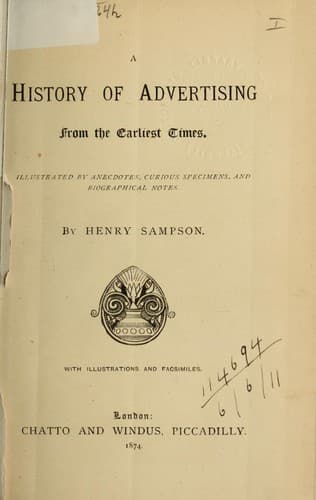
A History of Advertising from the Earliest Times.Sampson, Henry
History
A History of Advertising from the Earliest Times.
Sampson, Henry
Advertising -- History
civilisation are brought under our notice, as the busy life of bygone
generations bursts full upon us. We see the merchant at his door, and
inside the dimly-lit shops observe the fine ladies of the time deep in
the mysteries of brocades and other articles of the feminine toilet,
whose very names are now lost to even the mercers themselves. And not
alone intent on flowered mantuas and paduasoys are they, for we can in
fancy see them, keen ever to a fancied bargain, pricing Chinese teapots
or Japanese cabinets, and again watch them as, with fluttering hearts,
they assist at lotteries for valuables of the quality familiar to
“knockouts” of our own time. We hear the lament of the beau who has lost
his clouded amber-headed cane or his heart at the playhouse, and listen
to the noisy quacks vending their nostrums, each praising his own wares
or depreciating those of his rivals. We see the dishonest serving-man
rush past us on the road carrying the heterogeneous treasures which have
tempted his cupidity. Soon the “Hue and Cry” brings the same
ill-favoured malefactor before us in an improved character as
horse-stealer and highwayman; and ere long we hear of the conclusion of
his short drama at Tyburn. Thus the various advertisements portray, with
more or less vividness, lineaments of the times and the characters of
the people.
That the newspapers were early used for the purpose of giving
contradictions by means of advertisement, or effecting sly puffs, is
shown by the following, which was doubtless intended to call attention
to the work, and which was published in the form of an ordinary
paragraph in the _Modern Intelligence_, April 15-22, 1647:--
There came forth a book this day relating how a divil did appear in
the house or yard of Mr Young, mercer in Lombard St., with a great
many particulars there related; It is desired by the gentleman of that
house, and those of his family, that all that are credulous of those
things (which few wise are), may be assured that its all fabulous, and
that there was never any such thing. It is true there is a dog, and
that dog hath a chain, and the gentleman’s son played upon an
instrument of music for his recreation,--but these are to be seen,
which a spirit sure never was.
Public-domain text, read in full here on John Shaqi.
Reviews
Reviews
No reviews yet
Be the first to share your thoughts on this work.
Elsewhere in the archive
Join the Discussion
Join the discussion
Sign in to leave a comment or review.
Sign InorCreate an account