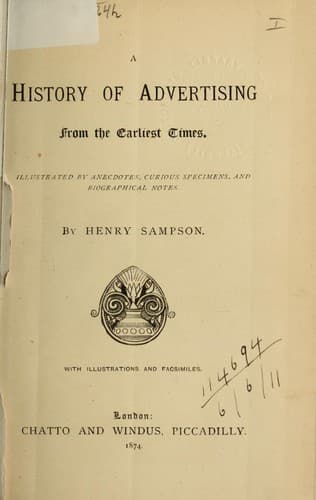
A History of Advertising from the Earliest Times.Sampson, Henry
History
A History of Advertising from the Earliest Times.
Sampson, Henry
Advertising -- History
It is supposed by some that the great amount of horse-stealing which
prevailed during the Commonwealth, and for the next fifty years, was
caused by an inordinate scarcity of animals consequent upon casualties
in the battle-field. This can hardly be correct, unless, indeed, the
object of the foe was always to kill horses and capture men, a state of
things hardly possible enough for the most determined theorist. One fact
is noticeable, and seems to have been quite in the interest of the
thieves--namely, that when at grass most horses were kept ready saddled.
This practice may have arisen during the Civil Wars from frequent
emergency, a ready-saddled horse being of even greater comparative value
than the traditional bird in the hand; and we all know how hard it is to
depart from custom which has been once established. That the good man
was merciful to his beast in those days hardly appears probable, if we
are to take the small black nag as evidence. His furniture, too, seems
much more adapted for service than show, despite its variety of colours;
and perhaps the animal may have been seized, as was not uncommon, by
some messenger of State making the best of his way from one part of the
kingdom to another. Before the year 1636 there was no such thing as a
postal service for the use of the people. The Court had, it is true, an
establishment for the forwarding of despatches, and in Cromwell’s time
much attention was paid to it; but it was, after all, often in not much
better form than when Bryan Tuke wrote as follows during the sixteenth
century: “The Kinges Grace hath no mor ordinary postes, ne of many days
hathe had, but betweene London and Calais.... For, sir, ye knowe well
that, except the hackney-horses betweene Gravesende and Dovour, there is
no suche usual conveyance in post for men in this realme, as in the
accustomed places of France and other partes; ne men can keepe horses in
redynes withoute som way to bere the charges; but when placardes be sent
for suche cause [to order the immediate forwarding of some State
packet], _the constables many tymes be fayne to take horses out of
ploues and cartes, wherein can be no extreme diligence_.” In Elizabeth’s
reign a horse-post was established on each of the great roads for the
transmission of the letters for the Court; but the Civil Wars
considerably interfered with this, and though in the time of Cromwell
public posts and conveyances were arranged, matters were in a generally
loose state after his death, and during the reign of his sovereign
majesty Charles II. Truly travelling was then a venturesome matter.
In 1659, also, we come upon an advertisement having reference to a work
of the great blind bard John Milton. It appears in the _Mercurius
Politicus_ of September, and is as follows:--
Public-domain text, read in full here on John Shaqi.
Reviews
Reviews
No reviews yet
Be the first to share your thoughts on this work.
Elsewhere in the archive
Join the Discussion
Join the discussion
Sign in to leave a comment or review.
Sign InorCreate an account