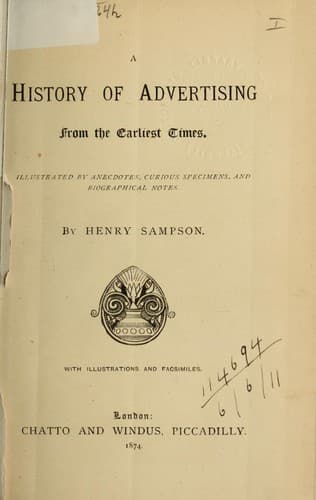
A History of Advertising from the Earliest Times.Sampson, Henry
History
A History of Advertising from the Earliest Times.
Sampson, Henry
Advertising -- History
WHEREAS _George Grey_, a Barber and Perrywigge-maker, over against the
_Greyhound Tavern_, in _Black Fryers_, _London_, stands obliged to
serve some particular Persons of eminent Condition and Quality in his
way of Employment: It is therefore Notifyed at his desire, that any
one having long flaxen hayr to sell may repayr to him the said _George
Grey_, and they shall have 10s. the ounce, and for any other long fine
hayr after the Rate of 5s. or 7s. the ounce.
Pepys, in his quaint and humorous manner, describes how Chapman, a
periwig-dresser, cut off his hair to make up one of these immense
coverings for him, much to the trouble of his servants, Jane and Bessy.
He also states that “two perriwiggs, one whereof cost me £3 and the
other 40s.,” have something to do with the depletion of his ready money
on the 30th of October 1663. On November 2nd, he says, “I heard the Duke
[Buckingham] say that he was going to wear a perriwigg; and they say the
King also will. I never till this day observed that the King is mighty
gray.” And then on Lord’s day, November 8th, he says, with infinite
quaintness, “To church, where I found that my coming in a perriwigg did
not prove so strange as I was afraid it would, for I thought that all
the church would presently have cast their eyes all upon me.” Pepys was,
it seems, possessed of that rather unpleasant consciousness which
prompts a man who wears anything new or strange for the first time to
believe that all the world, even that portion of it which has never seen
him before, knows he feels anxious and uncomfortable because he has got
new clothes on. The price, ten shillings the ounce, shows that there
must have been an exceptionally heavy demand for flaxen colour by the
wearers of the new-fashioned wigs. Judging by the advertisements just
quoted, as well as by those which follow, there can be no controverting
the statement that the reign of Charles II. “was characterised by
frivolous amusements and by a love of dress and vicious excitement, in
the midst of which pestilence stalked like a mocking fiend, and the
great conflagration lit up the masquerade with its lurid and angry
glare. Together with the emasculate tone of manners, a disposition to
personal violence stained the latter part of this and the succeeding
reign. The audacious seizure of the crown jewels by Blood; the attack
upon the Duke of Ormond by the same desperado, that nobleman having
actually been dragged from his coach in St James’s Street in the
evening, and carried, bound upon the saddle-bow of Blood’s horse, as far
as Hyde Park Corner, before he could be rescued; the slitting of Sir
John Coventry’s nose in the Haymarket by the King’s guard; and the
murder of Sir Edmondbury Godfrey on Primrose Hill, are familiar
instances of the prevalence of this lawless spirit.” There is still one
other memorable and dastardly assault to note, that on “Glorious John,”
and we shall do so in due course.
Public-domain text, read in full here on John Shaqi.
Reviews
Reviews
No reviews yet
Be the first to share your thoughts on this work.
Elsewhere in the archive
Join the Discussion
Join the discussion
Sign in to leave a comment or review.
Sign InorCreate an account