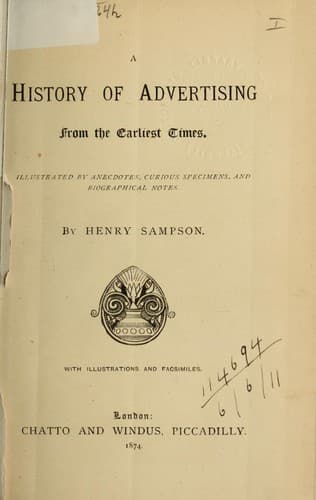
A History of Advertising from the Earliest Times.Sampson, Henry
History
A History of Advertising from the Earliest Times.
Sampson, Henry
Advertising -- History
Surely such men as Sedley, Rochester, Buckingham, and even Charles
himself, must have laughed at the infatuation of the multitude; for if
ever there was a king whose touch was less likely than another’s to cure
the evil, that king was, in our humble opinion, “his Sacred Majesty”
Charles II. But then people were prepared to go any lengths to make up
for their shortcomings in the previous reign. There was possibly a
political significance about these manifestations of royal ability and
clemency, and some enthusiasts, who believe devoutly in the triumph of
mind over matter, think there is reason to believe in the efficacy of
the touch in scrofulous affections, and even believe that people did
really recover after undergoing the process. Dr Tyler Smith, who has
written on the subject, boldly states his belief that the emotion felt
by these poor stricken people who came within the influence of the
King’s “Sacred Majesty” acted upon them as a powerful tonic; though, as
the King always bestowed a gold piece upon the patient, we think that if
good was derived, it was derived from the comfort procured by that--for
those who suffered and believed were generally in the lowest and poorest
rank of life--and perhaps travelling and change of air had something to
do with it as well. If the arguments of those who believe in the
emotional effect are to be admitted, it must be allowed by parity of
reasoning that where the touch failed, its failure would be likely to
cause the sufferers to become rabid republicans, the Divine right having
refused to exhibit itself. Maybe these latter symptoms, like the
symptoms of other diseases, did not develop in the individual, but came
out in course of generations, which may perhaps account for the large
amount of democracy which has exhibited itself during the present
century. There is certainly something rather ludicrous in the fact that
the practice of touching for the evil ceased with the death of Anne;
not because the people had become more enlightened, but because the
sovereigns who followed her were supposed to have lost the medicinal
virtue through being kings merely by Act of Parliament, and not by
Divine right.
The reaction which set in from the strait-laced rule of the Puritans at
the time of the Restoration, must have reached its height about 1664, if
we may judge by the advertisements then constantly inserted, which
reflect the love of pleasure and folly exhibited by all classes, as if
they were anxious to make up for previous restrictions. In fact, the
chief inquiries are after lacework, or valuables lost at masquerade or
water party, announcements of lotteries at Whitehall, of jewels and
tapestry, and other things to be sold. The following is a fair specimen
of the advertisements of the time, and appears in the _News_ of August
4, 1664:--
Public-domain text, read in full here on John Shaqi.
Reviews
Reviews
No reviews yet
Be the first to share your thoughts on this work.
Elsewhere in the archive
Join the Discussion
Join the discussion
Sign in to leave a comment or review.
Sign InorCreate an account