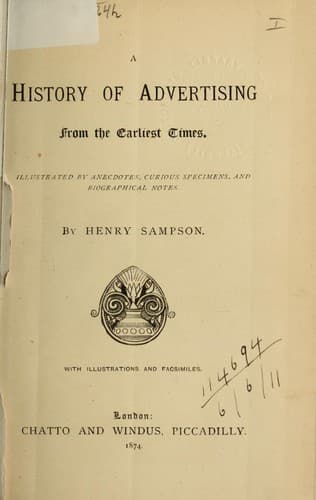
A History of Advertising from the Earliest Times.Sampson, Henry
History
A History of Advertising from the Earliest Times.
Sampson, Henry
Advertising -- History
Inquiries for hawks and goshawks are by no means scarce, and so we may
imagine that these implements of hunting were hardly so much to be
depended upon as those from the workshop of art and not of nature, which
are in use in the present day. Indeed, the falcon seemed to care much
less, when once set free, for his keeper, than writers of books are
prone to imagine. The King was apparently no more fortunate than the
rest of those who indulged in falconry, for in a copy of the _London
Gazette_, late in 1667, the following is seen:--
A Sore ger Falcon of His Majesty, lost the 13 of August, who had one
Varvel of his Keeper, Roger Higs, of Westminster, Gent. Whosoever hath
taken her up and give notice Sir Allan Apsley, Master of His Majesties
Hawks at St James’s, shall be rewarded for his paines. Back-Stairs in
Whitehall.
Sir Allan Apsley was the brother-in-law of the celebrated Colonel
Hutchinson, and brother of the devoted wife whose story everybody has
read. The next advertisement we shall select is published in the _London
Gazette_ of May 10, 1666, and has reference to the precautions taken to
prevent the spread of the Plague. Long before this all public notices of
an idle and frivolous nature have ceased, amusements seem to have lost
their charm, and it is evident from a study of the advertisements alone,
that some great disturbing cause is at work among the good citizens. No
longer does the authorised gambling under the roof of Whitehall go on;
no more are books of Anacreontics published; stopped are all the
assignations but a short time back so frequent; and no longer are
inquiries made after lockets and perfumed bags, dropped during amorous
dalliance, or in other pursuit of pleasure. Death, it is evident, is
busy at work. The quacks, and the writers of semi-blasphemous pamphlets,
have it all to themselves, and doubtless batten well in this time of
trouble. The Plague is busy doing its deadly work, and already the city
has been deserted by all who can fly thence, and only those who are
detained by duty, sickness, poverty, or the want of a clean bill of
health, remain. These bills or licences to depart were only granted by
the Lord Mayor, and the greatest influence often failed to obtain them,
as after the Plague once showed strength it was deemed necessary to
prevent by all and every means the spread of the contagion throughout
the country. The advertisement chosen gives a singular instance of the
manner in which those who had neglected to depart early were penned
within the walls:--
Public-domain text, read in full here on John Shaqi.
Reviews
Reviews
No reviews yet
Be the first to share your thoughts on this work.
Elsewhere in the archive
Join the Discussion
Join the discussion
Sign in to leave a comment or review.
Sign InorCreate an account