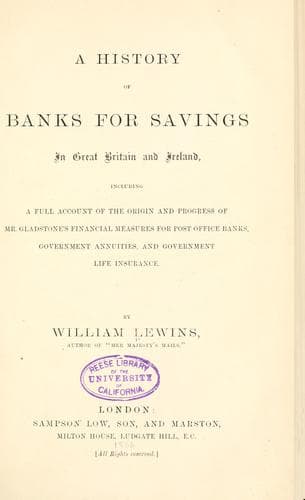
A History of Banks for Savings in Great Britain and IrelandLewins, William
History
A History of Banks for Savings in Great Britain and Ireland
Lewins, William
Postal savings banks -- Great Britain; Savings banks -- Great Britain
It, however, was not to be settled so soon. Before we refer to any
further expression of opinion on the subject in Parliament and the
ultimate decision in the case, it is only right that we should present
the other--the Savings Bank--view of the matter, as uttered by the
powerful, we had almost said corporate, body at St. Martin's Place.
The Committee of Managers of this important London institution met, as
their custom was, to pass resolutions on any matter affecting Savings
Banks. A petition to Parliament was framed on the resolutions come to
in this as in other instances, and similar petitions were got up and
presented to Parliament from other Savings Banks, who naturally looked
to the St. Martin's Place institution for advice and guidance. At a
meeting held at this representative bank on the 14th of May, 1850,
Lord Walsingham in the chair, the proposals of the Chancellor of the
Exchequer were gone through _seriatim_, and all of them, without
exception, disputed and condemned. It came to the conclusion that (1)
the proposed introduction into Savings Banks of a Government
treasurer, &c., "must lead to great confusion, and eventually to the
disruption of these valuable institutions;" (2) that "the proposed
reduction of the existing rates of interest and the limit in the
amount of deposits will, besides imposing injurious restrictions on
depositors, so diminish the means of defraying the expenses of
management as to render it extremely difficult in some, and impossible
in other cases," to engage efficient assistance; (3) that any further
reduction of the rate of interest to depositors would only tempt them
to withdraw their money from Savings Banks and place it in "more
attractive, but frequently hazardous investments;"[90] (4) that the
grand principle on which well-conducted Savings Banks have hitherto
been so efficiently managed, viz., "that of having the constant
superintendence of gentlemen unconnected with the receipt or payment
of money, will be destroyed if the new bill should be passed into a
law." We ought to add that this Committee did not object to the
abrogation of the law of 1844, which was passed "contrary to their
expressed wishes and recommendations;" that, although they urged that
frauds were comparatively rare, and far less in amount and extent than
in public or mercantile establishments, and that for such reason there
was no just ground for the introduction of an entirely new system such
as was now proposed, they had no objection to a measure adapted still
further to promote the solvency and good management of Savings Banks,
only they must insist that the necessity for such important changes
"should be considered by a Select Committee, and evidence taken from
men of long experience in Savings Bank management." The last
resolution to which this body came was, "That a petition to the House
of Commons, founded upon the foregoing resolutions, be printed and
circulated for the information of other Savings Banks."
Public-domain text, read in full here on John Shaqi.
Reviews
Reviews
No reviews yet
Be the first to share your thoughts on this work.
Elsewhere in the archive
Join the Discussion
Join the discussion
Sign in to leave a comment or review.
Sign InorCreate an account