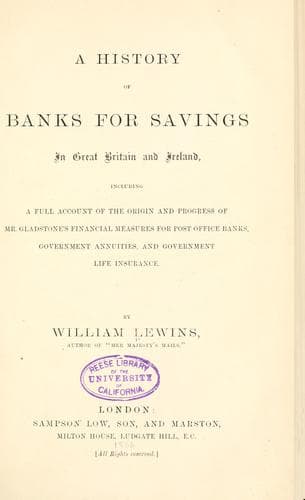
A History of Banks for Savings in Great Britain and IrelandLewins, William
History
A History of Banks for Savings in Great Britain and Ireland
Lewins, William
Postal savings banks -- Great Britain; Savings banks -- Great Britain
This was the great and distinguishing feature of the measure which the
Government was disposed to adopt; but there were other features in the
bill of considerable importance, which ought not to go unmentioned.
Thus, it proposed that the Act of 1844 should be repealed, and that
trustees should be responsible for their wilful neglect or default, as
in the Act of 1828. It was clear, however, that under the appointment
of treasurers the responsibility would be little more than nominal.
Another point which the bill provided for was an efficient audit of
the accounts, the trustees of each bank to appoint an auditor, and the
pass-book of each depositor to be annually examined, the auditor in
each case comparing the book with the ledger of the office.[87] The
bill proceeded, further, to give power to the National Debt
Commissioners to send down to any Savings Bank, should they see
occasion for it, an Inspector, to test the accuracy of the accounts of
that bank: with the other provisos already mentioned, depositors would
thus be absolutely safe. The next clause provided against any further
loss to Government. The Chancellor in introducing this subject spoke
of the different rates of interest which had been given to Savings
Banks, and said all of them were higher than could be given without
loss. But this was not all. The loss sustained in having to pay out a
large sum of money whenever called for, no matter how low the Funds
were at the time, was equal almost to the former. After explaining the
case, and giving examples of its working, he added that Government
thus suffered a loss on capital and a loss on interest. "It had been
proposed that Government should merely act as a broker, making
depositors subject to all the fluctuations of the Funds; but," said
the honourable gentleman, "from the numerous communications I have
received from all parts of the country, depositors think much of their
getting their money back as they put it in, and looked to the amount
of interest as a secondary consideration." He then gave a variety of
statistics, and proposed that the limit to the amount of deposits
should be fixed at 100_l._ and that the rate of interest should be
reduced from 3_l._ 5_s._ to 3_l._ for trustees, and 2_l._ 15_s._
instead of 3_l._ 0_s._ 10_d._ to depositors.[88] The Chancellor of the
Exchequer concluded by expressing the wish that the bill of which he
had given the principal clauses, should be discussed fully and
temperately: it involved no party feeling, but it involved many things
intimately connected with the welfare of the classes for which Savings
Banks were established: he said he had done his best to meet the
difficulties of the case, but difficult as it was to do, the matter
ought at once to be settled, and to be settled once for all.[89]
Public-domain text, read in full here on John Shaqi.
Reviews
Reviews
No reviews yet
Be the first to share your thoughts on this work.
Elsewhere in the archive
Join the Discussion
Join the discussion
Sign in to leave a comment or review.
Sign InorCreate an account