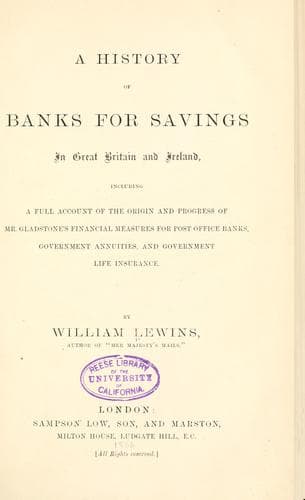
A History of Banks for Savings in Great Britain and IrelandLewins, William
History
A History of Banks for Savings in Great Britain and Ireland
Lewins, William
Postal savings banks -- Great Britain; Savings banks -- Great Britain
Early in 1853, and when he had but just succeeded to the office of
Chancellor of the Exchequer, Mr. Gladstone gave notice that the
subject must be taken up, and if possible settled. A bill[93] was
allowed to pass the second reading without discussion; but when the
subject came up before Committee in July of that year, Mr. Gladstone,
compelled to succumb to the wish that Parliament should be prorogued,
asked that this and other bills might be deferred till the next
meeting of Parliament. He said he had made great progress with the
bill since it was first introduced; he had sought to get the opinion
of the different Savings Bank managers upon it, and he believed he had
acquired a pretty accurate knowledge of the state of feeling in the
country on the subject.[94] All this was favourable to the prospects
of the bill; but now, as the House had lasted since November 1852, he
feared that if it was pushed forward it might fail to pass. He should
have liked to have got the question settled, but he now thought his
object would be more speedily obtained by the delay proposed. Here the
sagacious Minister was mistaken; the old adage of no time being better
than the time present could often be well applied to proposals to
defer desirable matters of legislation to a future session. No mention
was made of the subject for nearly eighteen months; the country had
more pressing, and, for the time, much more serious matters to
consider, which it will be quite unnecessary to particularize.
On the 20th of December, 1854, Mr. Gladstone moved for and obtained
leave to bring in two bills during the session of 1855: the one "to
create a charge on the Consolidated Fund" of the money due on behalf
of the depositors in Savings Banks, and the other, the bill for the
management of Savings Banks which was withdrawn in 1853. In the former
important proposal the Chancellor of the Exchequer desired to make the
law more perfect as to the relation between the depositor and the
State, by giving the latter a better title to the money invested with
the State. He wished, in his own language, "to reduce the obligation
and the contract of the State with the depositor to that simple form
which is adopted by every banker." He would propose, "as respects the
bulk of the funds received from Savings Bank depositors, that they
should be held in this country as they are held in other countries,"
and not in the complicated form of Stock and other public securities.
Mr. Gladstone's view, more than once expressed in strong terms, with
respect to the State using the money belonging to Savings Banks, was
that it was no matter to anybody what was done with the money,[95]
providing it were ready at call and the stipulated interest were
given,--the stability of the country being surely a sufficient
guarantee for its safety. Savings Bank authorities, on the other hand,
disputed the right of the Chancellor to use the money; would prefer to
Public-domain text, read in full here on John Shaqi.
Reviews
Reviews
No reviews yet
Be the first to share your thoughts on this work.
Elsewhere in the archive
Join the Discussion
Join the discussion
Sign in to leave a comment or review.
Sign InorCreate an account