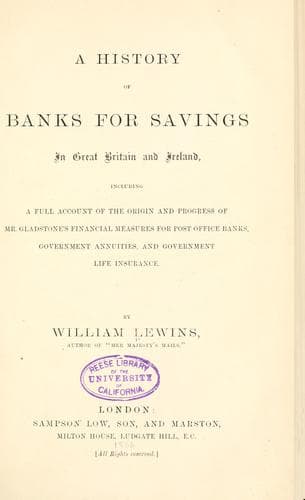
A History of Banks for Savings in Great Britain and IrelandLewins, William
History
A History of Banks for Savings in Great Britain and Ireland
Lewins, William
Postal savings banks -- Great Britain; Savings banks -- Great Britain
use it themselves in other investments, if the funds were applied
otherwise than under statute in the purchase of Bank Annuities; and
referred to the uncertain title in law which depositors had for the
money according to the governing statute. Mr. Gladstone's bill
proposed to give this title to every penny so deposited with the
State, by throwing the burden of any deficiency arising on the
Consolidated Fund, and so silence at any rate the last objection.[96]
Early in the session of 1857 the then Chancellor of the Exchequer (the
late Sir George Lewis) was several times asked if the subject of
Savings Banks had not to be brought forward and concluded. These
questions led to his promising to bring in the Government measure
which, often brought forward and as often withdrawn, was still waiting
for a tide of popular favour to carry it into law. On the 27th of
February in this year he gave notice of this intention, and earnestly
trusted that the House would allow it to pass. In a short speech, the
points of which we need not recapitulate--for it dealt with the same
facts and came to the same conclusion as those speeches of previous
Chancellors already described,--he proposed the first reading. Then
came the dissolution of Parliament, and its forcible postponement for
one more session.[97]
In a fortnight from the meeting of the new Parliament Sir G. Lewis,
true to his promise, moved that the House go into Committee on the
Savings Bank Bill, which had even then reached that stage. His motion
was, "That it is expedient to amend the laws relating to Savings
Banks, and to provide for the establishment of Savings Banks with the
security of the Government." The Chancellor said that almost everybody
was agreed as to the principles of the bill, though it was true that
the managers of many Savings Banks contested some of the details. The
greatest objection to the bill when last introduced being the
provision to limit the total amount of deposits to 100_l_., he would
now propose, as it did not affect the bill at all materially, to drop
that clause; the law to remain as it then stood. This was the only
material difference; there were minor points, but they were not worth
pointing out. He then went over the changes which the bill proposed to
make in the law; the ample security he wished to give to all who
deposited money in Savings Banks, at the same time taking no
superfluous securities and imposing no unnecessary restrictions in
order to guard the interest of the public. Should the local
authorities of Savings Banks still be found unwilling to part with
their own control, or admit any interference on the part of the
Government, there was only one course left to him--namely, "to abandon
the bill," to leave things in their present position, and continue a
system by which the depositors are left entirely to the security of
the local officers; while at the same time Government is left wholly
irresponsible, except for the amounts actually lodged in its hands. "I
Public-domain text, read in full here on John Shaqi.
Reviews
Reviews
No reviews yet
Be the first to share your thoughts on this work.
Elsewhere in the archive
Join the Discussion
Join the discussion
Sign in to leave a comment or review.
Sign InorCreate an account