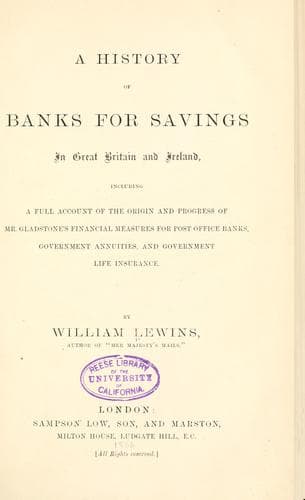
A History of Banks for Savings in Great Britain and IrelandLewins, William
History
A History of Banks for Savings in Great Britain and Ireland
Lewins, William
Postal savings banks -- Great Britain; Savings banks -- Great Britain
trust, however, that the plan will be considered a reasonable plan,"
said the Chancellor, in conclusion, "that it will be found not to
impose upon the local authorities any shackles of which they can
reasonably complain, and that no securities are demanded on behalf of
the public beyond what are absolutely necessary."[98] _Sir Henry
Willoughby_ held that the law needed consolidating before any new Act
was passed. It was not long since 200 petitions were presented to the
House for a consolidation of existing statutes, and an inquiry into
the entire system. Let the House take this step first. After speaking
warmly on the subject of the disposal of Savings Bank money, he
appealed to the Chancellor to refer the whole subject to a Select
Committee, who should recommend a clear and well-defined legislative
enactment. _Mr. Sotheron Estcourt_ and _Viscount Goderich_ took the
same view; the former gentleman, however, warmly approved of the
Government bill, which had "happily been re-introduced," and thought
that "most of the alterations made were improvements." As a trustee of
a Savings Bank he would consider his position infinitely improved by
the bill. If, however, the feeling of the House was for a committee,
this course could not prejudice the bill, though it would delay it.
_Mr. Thomas Baring_ thought the matter should go before a Select
Committee; so did Mr. Henley. The Irish members, Mr. Slaney and
others, were for passing the bill, and not deferring legislation any
longer on any pretence. The Chancellor of the Exchequer opposed any
further delay; the adoption of any other resolution would simply tend
to shelve the bill for another session. If honourable gentlemen really
wished to reject the bill, let them resort to the direct and fair
course of doing so. He also was for consolidating the laws relating to
Savings Banks; but till that could be done he thought it by far the
best plan to introduce a few more clauses into the law to remedy
grievances which could not wait to be redressed. The motion was then
agreed to. The second reading came off on the 8th of June. _Mr.
Ayrton_, in a long and animated speech, during which he said that the
greater number of Savings Banks were now most efficiently managed on a
principle which was most conducive in binding the humbler to the more
influential classes, and that he could conceive nothing more
calculated to destroy that sympathy than the present proposals--"felt
inclined to move that the bill be read a second time that day six
months." The result of the proposals would be a step in the direction
of the system which obtained on the Continent, where every function of
the community was usurped "by what was called the civil service of the
country." Amidst cries of "Divide," Mr. Ayrton said he was strenuously
opposed to any such system. _Mr. McCann_ said the whole body of the
people were unanimous in applauding the measure of the Chancellor of
the Exchequer. _Sir Harry Verney_ approved of the principle of the
Public-domain text, read in full here on John Shaqi.
Reviews
Reviews
No reviews yet
Be the first to share your thoughts on this work.
Elsewhere in the archive
Join the Discussion
Join the discussion
Sign in to leave a comment or review.
Sign InorCreate an account