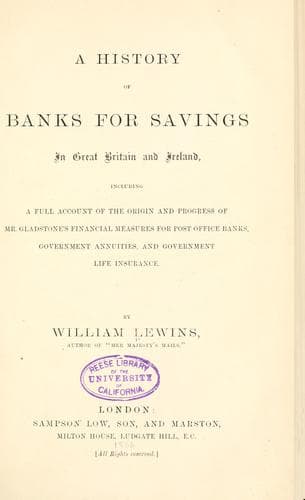
A History of Banks for Savings in Great Britain and IrelandLewins, William
History
A History of Banks for Savings in Great Britain and Ireland
Lewins, William
Postal savings banks -- Great Britain; Savings banks -- Great Britain
The improvement of which we have been speaking must not blind us,
however, to the darker side of the picture. Notwithstanding the
improvement which has been made, and the inestimable good which flows
from the practice and pursuit of frugality and economy, it is still
the exception and not the rule among the bulk of our labouring
population. For the hundreds who look to the exigencies of their life,
there are thousands who are utterly careless of such considerations,
and who, in the coarse enjoyment of the present, bury alike all
thought of the past and all expectation of and hope for the future.
The stigma of improvidence has long attached, and we fear must yet
long attach, itself to the generality of English artisans. But for
this stigma there would be no operatives in the world equal to the
English operative either in wealth, intelligence, or influence. No one
with any experience in the case, and with any care as to accuracy,
would venture to say that the English workman, _sui generis_, is not
industrious at his work,[6] but too many can say that he is not
provident in his home.[7] The English artisan has been said to be at
once the hardest worker and the hardest spender in the world. He works
like a horse and spends like an ass. So foolishly, indeed, is much of
this hard-earned money spent, or misspent, that it were a charity to
withhold it, or if it could be done, to throw it into the sea. The
consequences attending this riot of expenditure is as natural and as
inevitable as any of the laws of God's government. As one who knows
them well, and one who has done much for the intellectual culture of
the better portion of the artisan class tells us: "In a time of
prosperity they feast; in a time of adversity they _clem_." Any
depression of trade, be it even of the most transient nature, finds
them totally unprepared for it; those who have been accustomed to the
best wages invariably suffer the most; for, accustomed to the greatest
amount of indulgences, they can do worst without it. It is such
classes as these that must be reached by some means. In the
improvement brought about in the social habits of the people of late
years we have a happy augury of the future.[8]
Public-domain text, read in full here on John Shaqi.
Reviews
Reviews
No reviews yet
Be the first to share your thoughts on this work.
Join the Discussion
Join the discussion
Sign in to leave a comment or review.
Sign InorCreate an account