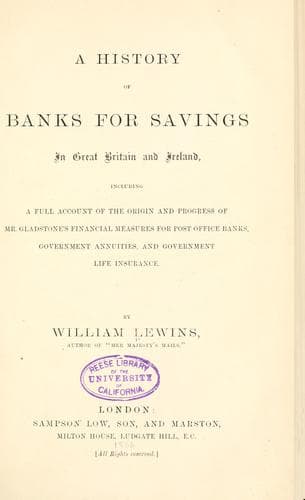
A History of Banks for Savings in Great Britain and IrelandLewins, William
History
A History of Banks for Savings in Great Britain and Ireland
Lewins, William
Postal savings banks -- Great Britain; Savings banks -- Great Britain
20, and last. That whenever any deposit shall amount to
150_l._, the Commissioners may, with the consent of the
depositor, invest a portion of that deposit in the
purchase for the depositor of 100_l._ stock, the interest
on which shall be received by the Commissioners and placed
to the depositor's account.
Arrived at this point, and in order that the general reader may
properly understand the next attempt made at legislation on behalf of
Savings Banks, we ought to say something in the way of explanation as
to the disposition of the funds of Savings Banks after they reach the
hands of Government. By the 57 Geo. III. c. 105, the money paid in on
Savings Banks account was to be invested in Three-and-a-half per Cent.
Bank Annuities.[103] Subsequently, the law was altered, by which the
money might be invested in Bank Annuities or Exchequer bills. The
purchases of Stock are made upon the order of the Comptroller-General
by the Government broker; but no Exchequer bills are bought, except
under the special direction of the Chancellor of the Exchequer. The
practice is, when the balance at the bank appears to be larger than is
necessary, gradually to apply it to the purchase of Stock at the price
of the day. It appears that between 1828 and 1844 Stock was sold to
the amount of 8,166,511_l._, and purchased to the amount of
8,816,400_l._; Exchequer bills were bought to the amount of
19,888,100_l._, and sold to the extent of 13,041,500_l._ Sir Alexander
Spearman stated that he had, on his own authority, bought Stock from
time to time, as the state of the balance required it; he contended
that he had legally such authority by virtue of his office, and he did
not hold himself responsible to give any explanation of his
proceedings to the trustees or managers of banks.[104] This was just
what Savings Bank managers and trustees did not agree with, and it was
an interpretation put upon the statute which even experienced
statesmen disputed.
Public-domain text, read in full here on John Shaqi.
Reviews
Reviews
No reviews yet
Be the first to share your thoughts on this work.
Elsewhere in the archive
Join the Discussion
Join the discussion
Sign in to leave a comment or review.
Sign InorCreate an account