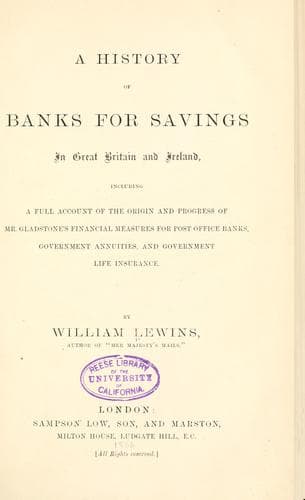
A History of Banks for Savings in Great Britain and IrelandLewins, William
History
A History of Banks for Savings in Great Britain and Ireland
Lewins, William
Postal savings banks -- Great Britain; Savings banks -- Great Britain
Mr. Wortley told the Committee of 1858 he considered the system of
mixing up the Savings Bank funds with the Government money very
injurious to Savings Banks. Mr. Boodle strongly objected to the
practice of dealing in Stock and Exchequer bills, and of exchanging
one for the other. He said Mr. Goulburn had been induced to
discontinue the practice, and to publish an account of the different
transactions, but that the practice had been revived in 1853, had
continued ever since, and in a worse form than ever. Lord Monteagle,
who spoke very strongly on these points, stated that the present use
of Savings Bank money was entirely at variance with the original
design; that the Commissioners had no power to change the securities,
and thus become active agents in the Stock Market.[105] Lord Monteagle
expressed strong objections also to the power of funding Exchequer
bills bought for the Savings Banks at the price of the quarter at
which they were bought. Sir A. Spearman, who was somewhat unfairly
left to bear all the brunt of every attack of this kind, on account of
the Committee neglecting to call upon any of those five members of the
House who were or had been Chancellors,[106] stated that the Savings
Bank fund on the 20th of November, 1857, was 34,399,082_l._ Stock;
whereas, if there had been no investment in Exchequer bills or bonds
since 1853, the amount would only have been 34,207,371_l._ Stock.[107]
Mr. Boodle dwelt upon the reputed losses which the country had
sustained through the Savings Banks, and declared that if there had
been any loss, it had been occasioned by the State not treating the
funds exclusively as Trust Funds. In this matter, Mr. Boodle
undoubtedly had the best of it. "Whenever any bill is introduced into
Parliament on Savings Banks," said this gentleman, "this loss is
thrown in the teeth of Savings Banks, and used as an argument,
sometimes for reducing the rate of interest, at other times for
reducing the limits of deposits, either annual or in gross. Therefore,
it acts most detrimentally to the depositors; and it has gone out that
the Savings Banks are an enormous expense, whereas we are perfectly
satisfied that, if this money were properly administered, there would
be no expense whatever.[108]"
Public-domain text, read in full here on John Shaqi.
Reviews
Reviews
No reviews yet
Be the first to share your thoughts on this work.
Elsewhere in the archive
Join the Discussion
Join the discussion
Sign in to leave a comment or review.
Sign InorCreate an account