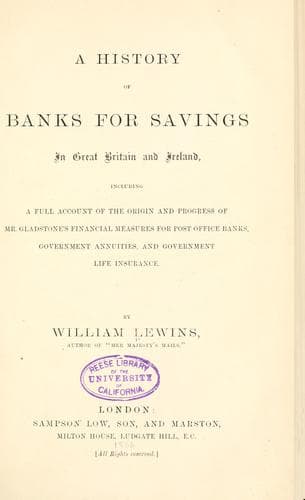
A History of Banks for Savings in Great Britain and IrelandLewins, William
History
A History of Banks for Savings in Great Britain and Ireland
Lewins, William
Postal savings banks -- Great Britain; Savings banks -- Great Britain
he had lost no time in taking action: hence the proposed bill. "From
speeches of honourable gentlemen," concluded Mr. Gladstone, "it might
be supposed that a dreadful bill had been introduced, giving
exorbitant powers to the Chancellor of the Exchequer. The fact is,
however, that there is not a power given which he does not already
possess, and in one or two respects the surrender of powers is very
large." "It is impossible that Savings Bank funds can now be used by
Government as a trust; they must be reserved for the discretion of the
House." The bill for the first time gives a positive title in law to
the deposits in Savings Banks, and it will further provide a true
account,--"for nobody has ever yet seen a true account,"--of the
National Debt; and for these reasons Mr. Gladstone hoped it would be
allowed to pass into law. _Mr. Thomas Baring_, and _Mr. Ayrton_,
unconvinced by the Chancellor's arguments, opposed the bill; and _Mr.
T. Collins_ contented himself, as usual, with dividing the House on
his motion to throw it out. The motion was negatived by a majority of
twenty-four, and there was a similar majority on a motion for
adjournment made by Sir Henry Willoughby. On the 20th of July, 1860,
the bill was considered in Committee, and the discussion was taken on
the first clause--the existing stock to be cancelled--when Mr. Hubbard
approved of the measure. By the bill the greater part of the money of
Savings Banks, viz., that treated as a book debt, would be placed
beyond the reach of jobbery. Sir Francis Baring spoke in favour of,
and Sir H. Willoughby, Mr. Hankey, and Colonel Sykes again opposed,
the clause. The opposition to the measure had gathered strength since
the last occasion;[109] and on a division, the Savings Bank managers
once more triumphed by a majority of 38, in a morning sitting and a
House of 192 members.
Public-domain text, read in full here on John Shaqi.
Reviews
Reviews
No reviews yet
Be the first to share your thoughts on this work.
Elsewhere in the archive
Join the Discussion
Join the discussion
Sign in to leave a comment or review.
Sign InorCreate an account