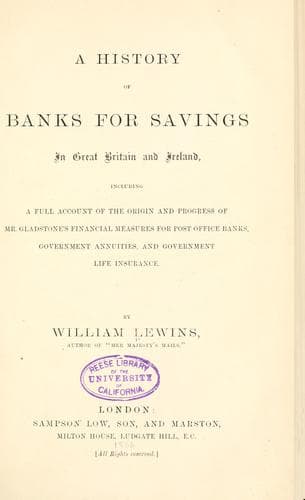
A History of Banks for Savings in Great Britain and IrelandLewins, William
History
A History of Banks for Savings in Great Britain and Ireland
Lewins, William
Postal savings banks -- Great Britain; Savings banks -- Great Britain
We have already made the reader acquainted with Mr. Gladstone's
opinion on the right of the State to use the money entrusted to it for
safe keeping; nothing could be more vigorous than his language already
quoted. Mr. Gladstone endeavoured to carry a change in the law
relating to the investment of Savings Bank moneys in 1855. He now, in
the session of 1860, came forward and offered a bill to remedy some of
the grievances complained of in the Committee. His proposals were now
substantially the same as those of 1855. He voluntarily proposed to be
shorn of his strength as Chancellor by the House agreeing to cancel
Savings Bank Stock to the amount of thirty-one millions of pounds; and
to open a new account for this money, to be called "State Deposit
Account, No. 1," virtually giving the money the fullest security of
the State, and placing it entirely beyond the reach of his operations.
The remaining amount, then about ten millions, Mr. Gladstone proposed
should be allowed to be invested at the pleasure of the finance
minister as heretofore. One would have thought that at any rate this
bill would have been allowed to pass quietly; but it was not to be.
The bill proposed was based on two of the recommendations of the
Committee of 1858,--namely, those which suggested that the power of
funding Deficiency and other bills should be done away, and that the
dealings in the stocks should be under the review of the House; but
members complained that a bill had not been prepared to embrace _all_
the recommendations. _Sir H. Willoughby_ and _Mr. Estcourt_ took this
view. In long speeches they both upheld the decision of the Committee,
and asked for a bill dealing with the entire subject; the latter
gentleman said that the "barren discussions in Parliament were acting
to the prejudice rather than to the support of the excellent
institutions with which they dealt. There were not above 600 of these
useful institutions in the whole kingdom, whereas they ought to ramify
through every parish and every village of the kingdom." _Mr. Malins_
and _Colonel Sykes_ followed, and complained that Government should
have neglected to deal with the entire subject. _Mr. Gladstone_ made
up for the lack of supporters by a long and able speech. He admitted
that it was most desirable to have a bill for the management of
Savings Banks, but the general subject had no relation to the mode in
which the money of Savings Banks was invested. Better at the end of a
session carry one or two points, and put an end to grievances which
had been loudly complained about, than bring in a measure only to
withdraw it again. He had been charged with ignoring the labours of
the Committee. He had not done so, for the bill was founded on part of
their labours; he _had_ considered the report, "but consideration does
not necessarily involve adoption." He was compelled to decline many of
the suggestions of the Committee. Where, however, he agreed with them,
Public-domain text, read in full here on John Shaqi.
Reviews
Reviews
No reviews yet
Be the first to share your thoughts on this work.
Elsewhere in the archive
Join the Discussion
Join the discussion
Sign in to leave a comment or review.
Sign InorCreate an account