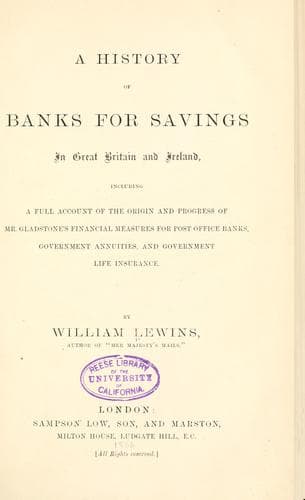
A History of Banks for Savings in Great Britain and IrelandLewins, William
History
A History of Banks for Savings in Great Britain and Ireland
Lewins, William
Postal savings banks -- Great Britain; Savings banks -- Great Britain
Left to themselves, the leading Savings Bank authorities in the
House--viz., Mr. Estcourt, Sir H. Willoughby, and Mr. Ayrton--obtained
leave, on the 11th of March, 1862, to bring in a bill "to Amend the
Laws relating to the Security and Management of Savings Banks."[110]
The points sought by the bill were, briefly, (1) to enforce upon all
local banks the regulations of the well-managed ones; (2) to repeal
the Act of 1844; (3) to force an auditor upon every bank and define
his duties; and, lastly, to provide for the security of the
depositors, by enacting that no transactions should take place except
at the office, during office hours, and in the presence and with the
signature of more than one person. Mr. Estcourt, who briefly explained
the drift of the bill, intimated that they were not desirous of
altering the relation in which Government stood to Savings Banks, or
of interfering in any way as to the disposition of the money. Mr.
Gladstone, after stating how completely Government had been baffled in
their attempts to alter the law regulating Savings Banks, expressed
approval of the bill, though he reserved the right of Government to
take any steps they chose at any subsequent stage.[111] On the 20th of
May this bill shared the fate of all preceding attempts to place these
institutions on a sound basis, by being withdrawn. Savings Bank
managers had again interfered, and this time they went against their
devoted friends. _Mr. Estcourt_, on withdrawing the bill, said he had
received numerous representations from managers that his measure was
"inapplicable" to them; and "only that day an influential body of
managers of great experience, and fully to be depended upon," had
waited upon him, requesting him to withdraw it; and if he would
consent to this course, _they_ would endeavour to devise some scheme
which should meet the requirements of the various establishments. Mr.
Estcourt's measure was unquestionably a good one, but it involved too
much trouble and risk to trustees: hence its defeat. _Mr. Gladstone_
thought it was high time that those gentlemen should take their turn
in devising a scheme. If they proposed a real improvement, Government
would make no objection. Referring to the Post Office Banks, Mr.
Gladstone said: "Undoubtedly, however, the main question had been
disposed of; they were now able to say to the people of England who
were disposed to lay by their savings, with a moderate interest and
with a perfect security, the Government had provided some 3,000 places
where these savings would be received." _Mr. Henley_ was much
discouraged with the difficulties everybody found in the way of
legislation. He was "disposed to think that the well-managed banks
might go on as usual," but rather than "tinker" at the others, "the
very small banks under the old system, which would not afford the
proper machinery for perfect management, ought to be urged to hand
over their business to the Post Office Banks." _Mr. D. Griffith_ "for
Public-domain text, read in full here on John Shaqi.
Reviews
Reviews
No reviews yet
Be the first to share your thoughts on this work.
Elsewhere in the archive
Join the Discussion
Join the discussion
Sign in to leave a comment or review.
Sign InorCreate an account