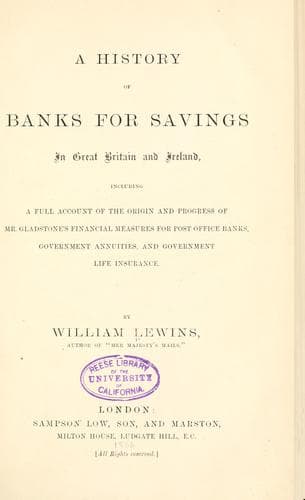
A History of Banks for Savings in Great Britain and IrelandLewins, William
History
A History of Banks for Savings in Great Britain and Ireland
Lewins, William
Postal savings banks -- Great Britain; Savings banks -- Great Britain
once agreed with the Chancellor of the Exchequer;" he was glad to hear
the Post Office Banks were working so well, and expressed his opinion
that "they would ultimately swallow up all the old banks."[112]
In March, 1863, Mr. Gladstone brought forward once more his
propositions relating to the investment of Savings Bank money. He
moved--
"That it is expedient to amend the laws relating to the
investment of the moneys of Saving Banks, and to create a
charge for such Savings Banks upon the Consolidated Fund,
in place of certain perpetual annuities now standing in
the names of the Commissioners of the National Debt; to
give the power for converting certain other amounts of
such perpetual annuities into certain other annuities, and
to provide for the due payment out of the Consolidated
Fund of any deficiency which may arise from insufficiency
of the securities to meet the legal claims of the trustees
of such Savings Banks."
After considerable discussion, the bill (26 and 27 Vict. c. 25) was
sent up to the Lords under the charge of Lord Stanley of Alderley, and
received the Royal Assent on the 8th of June, 1863.
We come now to the last item of legislation on the subject of Savings
Banks. On the 14th of April, 1863, Sir H. Willoughby and Mr. Ayrton
obtained leave to introduce the bill which, according to promise, had
been prepared by a convention of Savings Bank managers. To a great
extent this measure "to Consolidate and Amend the Laws relating to
Savings Banks," was identical with the one which Mr. Estcourt
introduced and withdrew during the previous session. The managers had
met during the recess, and had consolidated into one the eight Acts,
or parts of Acts, which then governed their establishments. Mr. Tidd
Pratt, on being consulted in the matter, certified that the new Act
"would constitute a fair and just measure of improvement." Mr.
Gladstone, too, it seems, had been furnished with a copy, had
suggested some trifling emendations, which had been frankly adopted
and embodied, and was therefore disposed to offer no captious
opposition to it. Not only so, but he thought it creditable to the
gentlemen who had it in charge, and, so far as it went, likely to be
effectual. Several clauses were altered, struck out, or inserted, and
the bill, known as the "Consolidation Act," received the Royal Assent
on the 28th of July, 1863. Of this Act (26 and 27 Vict. c. 87, a full
description of which will be found in the Appendix)[113] we shall
speak in a subsequent chapter, when we come to consider the law at
present regulating Savings Banks.
Public-domain text, read in full here on John Shaqi.
Reviews
Reviews
No reviews yet
Be the first to share your thoughts on this work.
Elsewhere in the archive
Join the Discussion
Join the discussion
Sign in to leave a comment or review.
Sign InorCreate an account