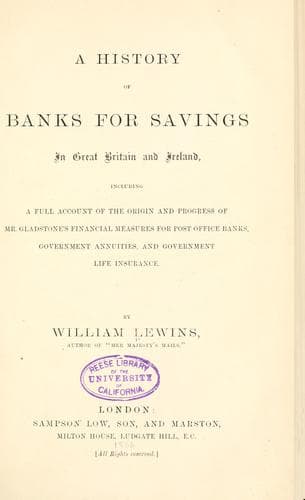
A History of Banks for Savings in Great Britain and IrelandLewins, William
History
A History of Banks for Savings in Great Britain and Ireland
Lewins, William
Postal savings banks -- Great Britain; Savings banks -- Great Britain
details that we will now turn. Claiming priority in all respects was
the fraud on the County of Kerry Savings Bank at Tralee.
The Tralee Savings Bank was established in 1823, many of the noblemen
and leading gentlemen of the neighbourhood taking part in its
formation. The secretary from the commencement was Mr. John Lynch, who
was appointed by a majority of the trustees at a salary of 60_l._ per
annum. From the commencement the bank was held at the house of the
secretary, and was open from two till four every Monday.[114] Among
the directors there were five clergymen, and the rest were highly
respectable gentlemen of Tralee. The same might be said of the twenty
managers, nearly half of whom were clergymen. The Rev. A. B. Rowan was
treasurer of the bank. In the pass-books were abstracts of the Rules
and Regulations of the bank, and these were headed by the following
motto:--
"For age and want save while you may,
No morning sun lasts a whole day."
Other useful injunctions were given in sober prose, such as "Examine
your pass-book, and see that the entry is correct." "If you lose this
book, give immediate notice at the bank, otherwise you may be
defrauded."[115] With what feelings the pages of the books containing
this sage advice would be turned subsequently, we leave the reader to
judge after he has learnt more. Of course, Lynch was highly respected
in the town: one witness describes him as, from the first of his
connexion with the bank till the exposure, a man above suspicion; and
Mr. Rowan, the treasurer, told the Committee of 1848, that he believed
the public generally "had more confidence in Mr. Lynch than they had
in many, or any, of the trustees themselves." (839.) That he was
clever, as well as "correct," is manifest from the fact that he
succeeded for sixteen years in carrying on, unsuspected by anybody, a
complete system of frauds of different kinds, by which he appropriated
to his own use during that time no less than an average of 2,000_l._ a
year. He seems to have commenced his dishonest practices soon after
the formation of the bank; but until 1832 his peculations were of
small amount. From 1832 to 1847 he practised every possible
description of fraud, and though some of them might have been detected
by a rigid system of check, nearly all of them were remarkable for the
ingenuity they displayed: "The contrivance and adroitness with which
he managed these frauds," says one who subsequently went over the
accounts of the bank, "were so ingenious as almost to defy detection."
One of his practices was to account for a less sum than he received
from a depositor, and this description of fraud he managed as follows
(and this is a case which actually occurred): He received for lodgment
three sums of 30_l._, 15_l._, and 27_l._ in one day, without any
assistance or supervision from trustee or manager. These amounts he
entered in his books as 3_l._, 5_l._, and 7_l._ respectively, and
pocketed the difference.
Public-domain text, read in full here on John Shaqi.
Reviews
Reviews
No reviews yet
Be the first to share your thoughts on this work.
Elsewhere in the archive
Join the Discussion
Join the discussion
Sign in to leave a comment or review.
Sign InorCreate an account