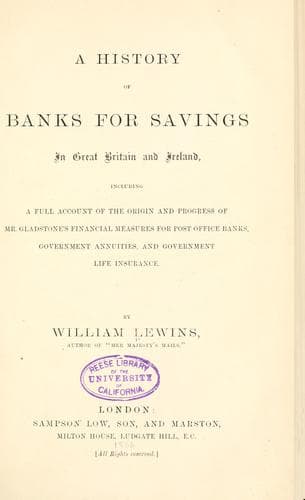
A History of Banks for Savings in Great Britain and IrelandLewins, William
History
A History of Banks for Savings in Great Britain and Ireland
Lewins, William
Postal savings banks -- Great Britain; Savings banks -- Great Britain
The manager at the close of the day, in
examining and certifying the business done, marked the three entries
as correct, as he found that they tallied exactly with the amount of
money received into the bank. No sooner, however, was the bank closed
and the acting manager left, than Lynch completed the case he had
commenced by securing himself against exposure in the event of the
depositor seeking to withdraw any of the sums named. The burden of the
fraud was made to fall upon the funds of the bank by the actuary now
altering the bank books to make them agree with the money actually
deposited; and this he did in the cases in question by putting an 0
after the figure 3, the figure 1 before the 5, and 2 before the 7. In
this way Lynch netted, with little or no risk of detection, a matter
of 57_l_. in one day. This was only one mode adopted. He likewise
received money out of office hours, which he never entered in any
day-book or accounted for to the manager. To preserve himself,
however, as in the previous case, he never forgot to post the amount
in the ledger, so that whenever it might be claimed it would appear to
the debit of the bank and at once be paid. Of course, there was here
the absence of everything like check or audit.[116] Other descriptions
of fraud may be left to be given in the culprit's own words.
Lynch held uninterrupted sway of the Tralee bank for a long series of
years, contriving to make away during the time with many thousands of
pounds; but retribution, though long in coming, arrived at last. "The
mill of God grinds late," says the Spanish proverb, "but it grinds to
powder," and the proverb meets with its exemplification here. A
trifling incident, as has often been the case before, led the way to
the full exposure. Lynch fell ill, to an extent which, though the bank
was held at his own house, precluded him from giving those precise
instructions which are eminently necessary in dealing with such
fragile machinery as that with which he had managed to work so long.
It was usual, it seems, to make weekly requisitions to the treasurer
of the bank for money to meet the demands upon its funds, and the
subordinate on the occasion in question asked for more money from that
functionary than had been credited to him altogether. The treasurer,
the Rev. A. Rowan, like the rest, had unbounded confidence in the
secretary, and had given himself little trouble over the affairs of
the bank. At a time when it must have been evident to all that several
thousand pounds sterling stood to the credit of depositors, Mr. Rowan
was satisfied to think that two or three thousand pounds formed the
capital of the bank. It is on record that he several times spoke of
the small amount of money in the bank, and innocently pointed to the
fact "as a sign of the depressed state of the country."[117] How this
illusion was at length dispelled we leave Mr. Rowan, himself to
tell.[118] "As I knew that the requisition of April 3d was for more
Public-domain text, read in full here on John Shaqi.
Reviews
Reviews
No reviews yet
Be the first to share your thoughts on this work.
Elsewhere in the archive
Join the Discussion
Join the discussion
Sign in to leave a comment or review.
Sign InorCreate an account