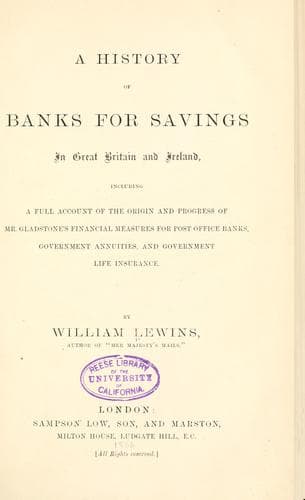
A History of Banks for Savings in Great Britain and IrelandLewins, William
History
A History of Banks for Savings in Great Britain and Ireland
Lewins, William
Postal savings banks -- Great Britain; Savings banks -- Great Britain
(878) "Can you state from the general feeling of the
country, what evil consequence will be the result of the
failure?--Taking the failure," says the witness, "in
connexion with the years of famine, I think the
consequence will be to drive the classes which have been
hitherto industrious and economical in their habits, to
vice and wickedness, because the dissipated characters who
have saved nothing, or did not take the trouble of saving,
now look upon the poor industrious creature who has been
cheated, laugh at him, and tell him that they have spent
their own money, while the industrious man has had
somebody else to spend his for him."
The agitation was at its height in Tralee when news came that the
neighbouring Savings Bank at Killarney had stopped payment. Mr. Pratt
had not even finished his awards in the one case before he was
required to investigate this fresh iniquity. It would seem that the
exposure of the one actuary had led to closer investigation on the
part of the trustees of the Killarney bank, and the earlier
development of the fraudulent proceedings of the other official. Here
again the frauds were found to be of an ingenious character, and might
have been continued over an indefinite period, but that the trustees
were compelled by the force of public opinion in the neighbourhood to
do the work they had taken upon themselves. As it was, the deficiency
was found to amount to 20,000_l._: the entire liabilities of the
Killarney bank were 36,000_l._, but the money in hand and the property
of the actuary, who decamped, which was calculated to realize about
5000_l._, reduced the loss to the former sum. As the average amount
due to each person was 45_l._ we may well conclude that the majority
of the depositors were of the poorer classes. Though the real loss was
less than in the case of the Tralee Bank, the bank at Killarney was
found to have been managed with greater carelessness; the trustees and
managers professed to make a yearly audit of accounts, but this to all
intents and purposes meant nothing more than taking the actuary's word
for everything. The details of this fraud have never, so far as we can
find, been made the subject of a searching public investigation, so
that little more is known than that the frauds in question were of the
usual character. Mr. Pratt, in a short report which he presented to
the Lords of the Treasury after he had visited the place, said that he
found the one case to be very similar to the other (Tralee), both as
regards the actuary and the managers. In both cases the accounts of
the treasurer were correct, and in both had the trustees grossly
neglected their duties. Here again he made awards against the bank to
a large amount, and in one respect these awards were much called in
question. This public officer received much blame, both in and out of
Parliament, for the character of his decision, whereas it seems quite
Public-domain text, read in full here on John Shaqi.
Reviews
Reviews
No reviews yet
Be the first to share your thoughts on this work.
Elsewhere in the archive
Join the Discussion
Join the discussion
Sign in to leave a comment or review.
Sign InorCreate an account