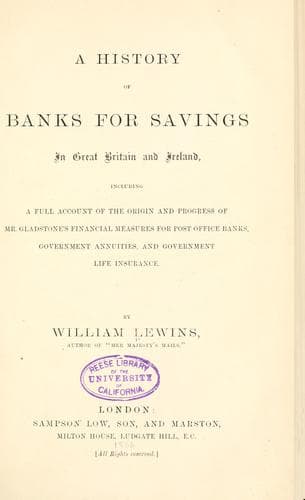
A History of Banks for Savings in Great Britain and IrelandLewins, William
History
A History of Banks for Savings in Great Britain and Ireland
Lewins, William
Postal savings banks -- Great Britain; Savings banks -- Great Britain
investigation of the affairs of the bank, and in making his awards in
the case. That investigation showed the most culpable neglect on the
part of the managers and trustees: Lynch had been engaged in his
nefarious practices for fifteen years, and yet till the day he made
his confession a breath of suspicion never reached one of them. The
confidence of the trustees in the man was so unbounded, that one
trustee would sign anything he wished; and the other, who generally
acted, signed because he saw the name of his fellow-trustee. Mr. Pratt
ascertained that here, as at Cuffe Street, the law had been
systematically violated; depositors had put in money to any extent;
they had deposited their money at all times, and under all kinds of
circumstances; charitable institutions deposited their funds without
any limitation, one fund having at one time had as much as 5,000_l_.
in the bank. Mr. Pratt, in making his awards, had to take all these
facts into consideration, giving satisfaction so far as it was in his
power to those who had made their deposits legally, and refusing it in
all other cases. In this way he made awards on the trustees of the
bank to the sum of over 16,000_l_. The trustees disputed their
liability on the strength of the Act of 1844, and when the case was
brought before the Court of Queen's Bench the decision of the
barrister was set aside. To this day, we believe, the unfortunate
depositors in the Tralee Bank have in no sense, either by private
benevolence or Government aid, been recompensed for their loss.
When the blow first fell with all its crushing weight upon the people,
they are described as having borne it "with wonderful patience;" then
this state of things was followed by a period of stolid indifference
to all the ordinary maxims of thrift and prudence, as if their
treatment had destroyed the growth of provident habits. So much is
evident from the statements of a respectable solicitor at Tralee who
was examined before the Committee of 1848:--
"Can you state (Mr. Herbert to Mr. Justin Supple, 872),
from your own knowledge, what class of persons the
depositors are, generally speaking?--Generally speaking,
they are composed of servants, artisans, mechanics, and
small shopkeepers. There are a few of a higher class, but
they are very few indeed. I have pass-books with me
amounting to about 16,000_l_., and I assure the Committee
that there is not a case in which I could not point out a
more or less considerable degree of hardship." He then
stated several cases.
Public-domain text, read in full here on John Shaqi.
Reviews
Reviews
No reviews yet
Be the first to share your thoughts on this work.
Elsewhere in the archive
Join the Discussion
Join the discussion
Sign in to leave a comment or review.
Sign InorCreate an account