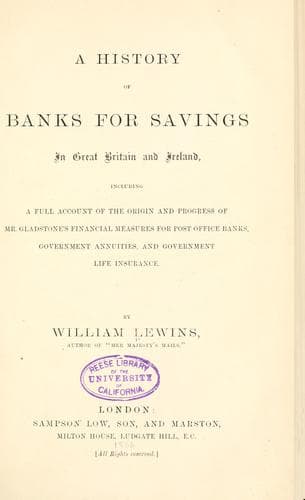
A History of Banks for Savings in Great Britain and IrelandLewins, William
History
A History of Banks for Savings in Great Britain and Ireland
Lewins, William
Postal savings banks -- Great Britain; Savings banks -- Great Britain
Haworth's solicitor told the unwelcome story of a deficiency. Enough
was said to make the trustees at once decide to call in the
depositors' books, and in the course of a few days it was
ascertained--though it took a much longer time to credit it--that the
liabilities of the bank amounted to 100,403_l._, that the total assets
were calculated to realize 28,686_l._, and that the deficiency
amounted to the enormous sum of 71,715_l._ In the course of two or
three weeks the trustees made the announcement of the defalcations to
the public, with what result may be better imagined than described. At
first the depositors took the matter very calmly--a feeling in which
was mingled incredulity; and a disbelief that they would be allowed to
lose so much money got possession of the people's mind. The general
opinion was, till undeceived, that the Government would have to stand
to the loss.[124] Of course this made it all the more deplorable when
the real facts became known. One of the witnesses who was examined
before Mr. Slaney's Committee on the savings of the middle and working
classes (1850), gave the following evidence of the feeling in Rochdale
at the time:--"I was in Lancashire some time ago, meeting with large
bodies of working men at the time of the failure, and I shall not soon
forget some remarks that were made about the Government. One man said,
'Dr. McDowall came here, and told us that the Government was a set of
robbers, and that they did not care about the property of the working
men.' He said, 'I did not believe Mr. McDowall then; but when I see
there is no security for the savings of the working men in the Savings
Bank, and we supposed Government had them under their protection, I
believe now that Mr. McDowall was right, and that Government cares
nothing about either the poor man or his savings.'" Of course we give
this extract simply to show the effects of the fraud on the minds of
the poorer classes, for nothing could be more unfair than such
conclusions. Soon the depositors came to look the loss fairly in the
face; they elected a committee of their number to act for the rest,
and Mr. Taylor, the witness before the Committee of 1858, was
appointed chairman; they agreed to avoid litigation if possible, and
relied on private benevolence and the possibility of a grant from
Government to make up the deficiency. The sum of 17,000_l._ was
readily subscribed among the trustees and their friends; another sum
of 17,000_l._ was realized out of Haworth's estate, and ultimately the
managers were enabled to give a dividend to depositors of 12_s._ 6_d._
in the pound.
Public-domain text, read in full here on John Shaqi.
Reviews
Reviews
No reviews yet
Be the first to share your thoughts on this work.
Elsewhere in the archive
Join the Discussion
Join the discussion
Sign in to leave a comment or review.
Sign InorCreate an account