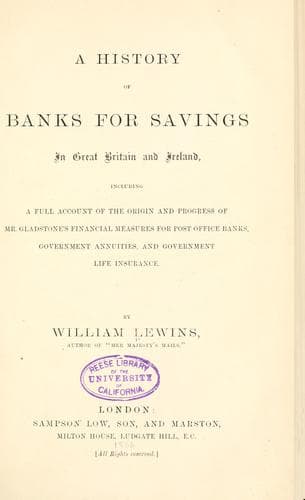
A History of Banks for Savings in Great Britain and IrelandLewins, William
History
A History of Banks for Savings in Great Britain and Ireland
Lewins, William
Postal savings banks -- Great Britain; Savings banks -- Great Britain
Thanks to Mr. Taylor's intelligent evidence, we have not only gleaned
the above particulars, but we are enabled to give some account of the
way the Rochdale frauds, which entailed so much misery and so much
loss, were accomplished. As the first question likely to arise in the
mind of the reader would be, doubtless, to ask where were the
trustees, it would be wise to dispose of it first. Haworth "was
exceedingly respected, and everybody had faith in him," says Mr.
Taylor, naïvely; "but from what we discovered, he must have been
exceedingly designing for many years." In no instance that has come
within our notice were the trustees, who ought to have been this man's
master, so completely his tools. Haworth was so much the factotum of
the bank that he really appointed the trustees; and so "designing" was
he, that when he got some one appointed who was likely to attend to
his duties, or be otherwise troublesome, he took care to keep the
knowledge of the appointment to himself. Mr. Taylor gave his own case
in corroboration. This gentleman found out afterwards, that he had
been appointed a manager in 1838, and never was aware of the
interesting fact _till the bank failed_ in 1849. "I never was at any
meeting; I never was called upon to attend any meeting; and I can name
several others in the same way."
Of course Haworth took care to make a show of having trustees. When
the same witness was asked (qu. 3,175), if any attended, he said that
"one or two attended occasionally; one very old man indeed, who was
Haworth's tailor, really was a trustee, and he attended, I dare say,
once or twice a month, and sat in the bank; but he was a very imbecile
old man, and would do whatever George Haworth told him to do."
Sometimes Haworth had to manoeuvre a little in order to get his
returns signed, and then he would resort to the trustees whom he in a
manner kept in stock. A case in point is recorded. A gentleman named
Chadwick was passing the bank during one of Haworth's times of need,
and the actuary called him in, and asked him to be kind enough to sign
a return. Mr. Chadwick naturally hesitated, as having nothing to do
with the bank. "But thou art a manager," said Haworth, showing him his
name, for the first time, in a printed list; and Mr. Chadwick,
thinking that he had perhaps just received this mark of the actuary's
esteem, at once fell in with his request, and signed the return.
Public-domain text, read in full here on John Shaqi.
Reviews
Reviews
No reviews yet
Be the first to share your thoughts on this work.
Elsewhere in the archive
Join the Discussion
Join the discussion
Sign in to leave a comment or review.
Sign InorCreate an account