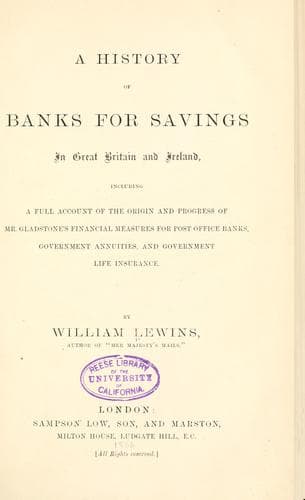
A History of Banks for Savings in Great Britain and IrelandLewins, William
History
A History of Banks for Savings in Great Britain and Ireland
Lewins, William
Postal savings banks -- Great Britain; Savings banks -- Great Britain
Haworth knew better than neglect to make out and send the proper
"returns;" the expedients, however, by which he contrived to get them,
false and true, signed, were wonderful for their cunning and daring
rascality. It is impossible to spare space to describe them in detail.
"Is it your belief," said Mr. Sotheron Estcourt to the Rochdale
witness, "that the returns were always properly furnished?" "I should
say so," said Mr. Taylor; "Mr. Haworth _was exceedingly exact_!" When
asked why the managers and trustees did not look at the papers to
which they put their names, Mr. Taylor said, in justice to these men,
that "George Haworth's power of deception was very great, and they
were deceived by him." When it suited him he would deceive a gentleman
into taking office, and then constantly deceive him in the execution
of the duty allotted to him. He went to one gentleman and asked him to
become a trustee; the person excused himself on account of his
business occupations and the risk; Haworth said that the
responsibility was with Government, and showed him a draft bill which
had never been passed into law! Satisfied on this point, the person
then inquired as to his duties. The arrant rogue said he wanted his
name to act as a check on the managers, and sign orders for money
which they had audited; _for_ "_the managers manage the bank_." When
Haworth had obtained the names of gentlemen to act as trustees, &c.,
on some false pretence or other, he had the audacity to trade upon
their names. If any poor person, on becoming a depositor, began to
express any doubt about security, Haworth, "who was much looked up to
in the town by the poor," made answer: "Thou seest the names of these
gentlemen; what dost thou think of them?" Having succeeded so
thoroughly in beguiling those persons who ought to have acted as a
check upon him, all the rest was comparatively easy to a clever and
shrewd person like Haworth. Him task was far easier, indeed, than that
of some of the Irish actuaries; and once the ascendency gained over
the trustees, nothing but close attention and a vigilant _confidant_
were required. The first defalcation was traced back to 1837, and
consisted of his forging the receipt of different persons whom he
represented as having received certain sums of money. The great bulk
of the fraudulent transactions was accomplished, however, by the
actuary keeping two sets of books, one of which, marked, "H," were his
private books, and the other the public ones. In his private book were
found the accounts of nearly a thousand depositors, who, it seems, had
been carefully chosen as having the largest sums in the bank, and who
generally were bringing additions to their store, and seldom drawing
upon it: these moneys he accounted for, "for he was exceedingly
exact,"--but only in his private books; he never entered them in the
regular bank books, and they were never acknowledged by any one but
himself. Under any sort of supervision or audit from a disinterested
Public-domain text, read in full here on John Shaqi.
Reviews
Reviews
No reviews yet
Be the first to share your thoughts on this work.
Elsewhere in the archive
Join the Discussion
Join the discussion
Sign in to leave a comment or review.
Sign InorCreate an account