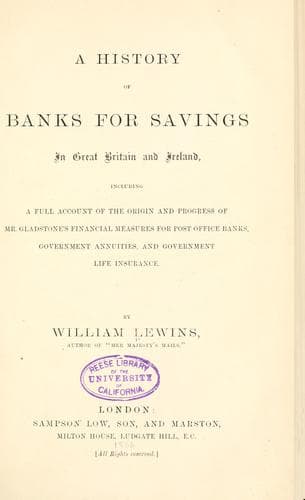
A History of Banks for Savings in Great Britain and IrelandLewins, William
History
A History of Banks for Savings in Great Britain and Ireland
Lewins, William
Postal savings banks -- Great Britain; Savings banks -- Great Britain
On the 3d of January, 1862, the announcement was made in the _Times_
newspaper that the Bilston bank had come to a sad end, and that
defalcations to the amount of 8,840_l._ had been found out in the
accounts of the treasurer of that bank. How these frauds, which
extended over several years, were accomplished, and how they were
found out, remains to be seen. We will reverse this order, and speak
of the exposure first. In the spring of 1861, Mr. Tidd Pratt, the
energetic Registrar of Friendly Societies--whose name indeed seems
almost synonymous with such subjects--visited Bilston, and delivered a
lecture on "Benefit Societies." In the course of that lecture Mr.
Pratt alluded to the cognate topic of Savings Banks, and spoke of the
necessity for regular accounts and regular returns in connexion with
them. He then took the opportunity to refer to the "very irregular
manner" in which the accounts of the bank in their own town were kept.
Now, it must not be supposed that Mr. Fletcher had forgotten his
returns; he was far too careful for that; he knew the penalties
attaching to such neglect. It seems that both weekly and annual
returns, although they were habitually and carefully "cooked," were
regularly forwarded to the National Debt Office. The "Returns" to
which Mr. Pratt appears to have pointed, were those called for
annually by the House of Commons, with the object of improving the law
of Savings Banks; and these returns, from 1855 to 1861 the factotum of
the Bilston bank had constantly neglected to send. Mr. Pratt, in
continuation of his statement afterwards, confessed he knew nothing of
the circumstances of the bank, further "than that his suspicions were
always aroused in cases where he found any accounts were not properly
rendered." There can be no doubt about it, that this reference roused
the "reverend defaulter" to a sense of his danger; for it subsequently
transpired that not a penny was abstracted unlawfully from the bank
after the week of Mr. Pratt's visit and lecture. Furthermore, not only
was the culprit aroused, but the trustees were awakened to some sense
of their responsibility, and very soon afterwards there was a movement
amongst them for a change in the management and an overhauling of the
books of the bank. In a very few weeks after Mr. Pratt's visit a new
set of managers and trustees were proposed, and Mr. Fletcher was
deputed to see them, and endeavour to get them to act. In July the
appointments were legally made, including that of Mr. Hawkesford to
the post of actuary. Then quickly followed the disclosure which
indeed, sooner or later, was now inevitable. The new actuary got the
books from the parsonage--the bank being held in the school-room of
the church--and was not long in finding out some of the discrepancies
with which they abounded. On first discovering the frauds the actuary
spoke to the treasurer, who promised to confer with him about them; on
finding out the magnitude of the defalcations, he again mentioned the
Public-domain text, read in full here on John Shaqi.
Reviews
Reviews
No reviews yet
Be the first to share your thoughts on this work.
Elsewhere in the archive
Join the Discussion
Join the discussion
Sign in to leave a comment or review.
Sign InorCreate an account