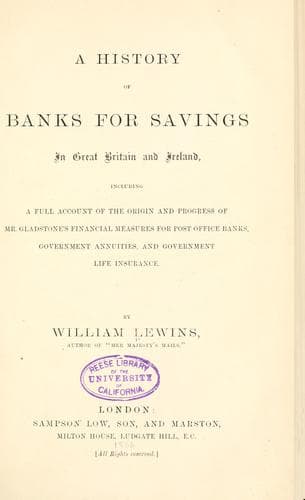
A History of Banks for Savings in Great Britain and IrelandLewins, William
History
A History of Banks for Savings in Great Britain and Ireland
Lewins, William
Postal savings banks -- Great Britain; Savings banks -- Great Britain
matter, choosing an extraordinary time, not however without its
significance--of a Sunday after the usual service. The clerical
delinquent acknowledged his guilt, and said, "He was very sorry, but
never intended to defraud the depositors of a shilling." It will be
seen, however, that the fraudulent transactions were of such a nature
as not to admit of any extenuation, and to render condonation of any
sort impossible. The feeling produced by the disclosure was painful in
the extreme, and the country spoke out with vigour on this
extraordinary and merciless breach of trust. The local magnates,
indeed, and the body of trustees who had allowed these frauds to run
on, spoke with bated breath of the "deficiencies" of the Bilston
treasurer; the _Times_, on the other hand, spoke far more in accord
the with the general feeling of the country, when it characterised
"this man Fletcher" as "the meanest, the most cowardly, and the most
cruel of swindlers."[127] Under his manipulations, the Bilston bank
was a Savings Bank in nothing but the name; there were trustees, but
they were tools; rules, properly certified, but never obeyed; accounts
made out and "cooked," but never checked or audited. The trustees did
just what they were bid, and the real operator at the bank did just
what he chose. This clergyman and magistrate was a swindler, his books
a heap of lies, his balance-sheets pure fiction.
Mr. Pratt was sent for to examine into the state of the bank
immediately after its condition became known, and it is to the account
which he himself subsequently gave to the depositors that we are
indebted for most of the particulars which elucidate Mr. Fletcher's
mode of operation, when in the thick of his guilt. Mr. Pratt stated,
that from 1848 to January, 1861, there did not appear to have been any
meeting either of the trustees or managers, for the purpose, according
to the rules, of auditing or settling the weekly accounts. The Rev. R.
J. Heafield, a trustee and manager of the bank, confessed at the trial
of Mr. Fletcher, at the Staffordshire Lent Assizes, 1862, his own
culpable negligence in the following words:--"The weekly returns
signed by me were prepared by Mr. Fletcher. _When I signed them, I
never in any way compared them with the books._ They were presented to
me either by Mr. or Mrs. Fletcher, _and I took no measures to verify
their accuracy._"[128] What might not a designing man do with such a
tool as this? Having subdued his trustees in this way, the rest was,
as we shall see, quite easy. The books at the bank were, it is only
fair to say, kept quite correctly; so were the depositors' books.
According to the evidence of Mr. Pratt: "In the day-book everything
was entered with scrupulous correctness; and 1200 depositors out of
1400 had brought in their books, and he did not believe an error had
been discovered." Mr. Fletcher chose a somewhat simpler course of
action, which we will describe. His duty as actuary of the bank
Public-domain text, read in full here on John Shaqi.
Reviews
Reviews
No reviews yet
Be the first to share your thoughts on this work.
Elsewhere in the archive
Join the Discussion
Join the discussion
Sign in to leave a comment or review.
Sign InorCreate an account