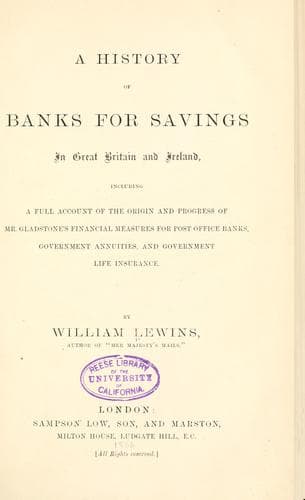
A History of Banks for Savings in Great Britain and IrelandLewins, William
History
A History of Banks for Savings in Great Britain and Ireland
Lewins, William
Postal savings banks -- Great Britain; Savings banks -- Great Britain
required that he should furnish weekly returns of the transactions to
the National Debt Commissioners: the correctness of these returns were
to be checked by the treasurer, which office he of course filled
_himself_. All that was necessary to the perpetration of fraud was
that this actuary-treasurer should be on easy terms with his
conscience, and this unfortunately was the sad state of the case.
Deceive the Commissioners by falsified returns, and any amount of
money, under the peculiar arrangements of this bank, might be pocketed
without fear. In order to help himself to a full solution of the case,
Mr. Pratt brought these returns down from London, and compared them
with the bank accounts, with the following result:[129]--"The whole of
the Returns he held in his hand were signed by Mr. Fletcher, as
actuary and manager. In the statement dated January 1, 1859, the
amount received was returned at 234_l._ On looking at the books for
that day, he found it should have been 334_l._, therefore 100_l._ had
been abstracted on that day [cries of 'Shame,' and sensation]. On the
8th of January, he found the payments were set down at 174_l._,
whereas they had only been 74_l._, thus showing that the treasurer had
put another 100_l._ in his pocket that week. In the return dated
January 29, the receipts were set down at 183_l._, and the payments at
148_l._, whereas the former ought to have been 283_l._, and the latter
48_l._, thus taking to himself 200_l._ [renewed sensation]." So on
through almost all the weekly accounts of three or four years. There
seems to have been no other fraudulent transactions than those of this
simple but abominable kind; the whole defalcation had taken place in
this way, and it was made manifest that no one but the treasurer had
participated in it. It is fortunate for the depositors that the frauds
were found out when they were; but for the negligence in sending the
required returns ordered by the House they might have been continued
for an indefinite period. As it was, the assets of the bank realized
in the first instance ten shillings in the pound; towards the close of
1862, another dividend of half-a-crown in the pound was paid, and
since that time a third small amount has accrued to the depositors,
who are never likely to be completely reimbursed of their loss. In
1862, Mr. Fletcher was tried before Baron Channell, and found guilty
of "appropriating money with intent to defraud." His counsel, however,
having made an able defence, characterised by the judge as being as
subtle as it was ingenious, the point as to whether the prisoner was a
"trustee" at the time of appropriating the money--this being one of
the facts upon which the indictment was based--was reserved, and he
was released on heavy bail. Into the further history of this man, the
sequestration of his living by the Bishop of Lichfield for the behoof
of the depositors, the repeated failures of justice in his case, his
Public-domain text, read in full here on John Shaqi.
Reviews
Reviews
No reviews yet
Be the first to share your thoughts on this work.
Elsewhere in the archive
Join the Discussion
Join the discussion
Sign in to leave a comment or review.
Sign InorCreate an account