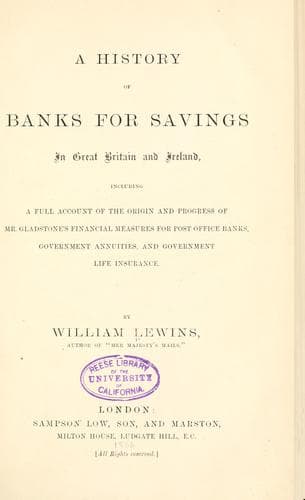
A History of Banks for Savings in Great Britain and IrelandLewins, William
History
A History of Banks for Savings in Great Britain and Ireland
Lewins, William
Postal savings banks -- Great Britain; Savings banks -- Great Britain
The last case[131] in the catalogue of this peculiar description of
crimes is that which occurred at Canterbury during the year 1865. This
case is indeed so recent that any lengthy description of it would
scarcely be tolerated. We may well spare ourselves the trouble, for
the Canterbury fraud was little else than a repetition, on a smaller
scale, of the one perpetrated at Rochdale, to which we have given so
much space. Nor is it a little singular that the actuary in the
Rochdale case was in many respects the prototype of the Canterbury
actuary: in the estimation in which both were held in their respective
spheres, in their character and occupation, there are several points
of close resemblance between them. In the Canterbury case we have the
old story of misplaced confidence, want of check, and a constant
embezzlement of considerable sums of money extending over a long
series of years. The actuary and secretary of the Canterbury bank, Mr.
Samuel Greaves, was for many years almost the sole responsible
official; of course "he bore the highest possible character for
probity and honesty": nor will it surprise any of our readers to be
told that it came afterwards to be said of this man, "from his many
professions he was thought incapable of such conduct as that which was
proved against him." The Canterbury bank was established in 1816.
Greaves's connexion with the institution dates from 1830, when he was
appointed actuary at a salary of 40_l._ per annum. The salary,
however, was increased from year to year, up to the time of the
exposure, when it stood at the respectable figure of 200_l._
Originally a "hoyman," the actuary of course, and necessarily, engaged
in other pursuits than those connected with the bank; and this
circumstance, in the same way that it occurred in almost every other
fraud of the kind, led to the malappropriation of the money of the
bank. It was another case of partial service and partial pay, and an
almost unlimited command of money, when among many other business
engagements it was always possible that money might be urgently
needed. Like Haworth of Rochdale, Mr. Greaves undertook several
agencies, among them those for the sale of coal and porter. In 1840,
it seemed, from the statements of his counsel, he began to lose money
in his business, and was then, to put it in the mild form chosen at
his trial, "induced to abstract some of the funds of the bank to meet
his pressing difficulties." Once on the downward road, he never turned
back; it was impossible to manage it. It was the old story, told with
plainness by his own advocate. He took the money, with the full
intention of repaying it on an early date; difficulties gathered fast
around him, and still the man went on, foolishly trusting to some turn
of fortune's wheel to replace him in his old position. He tried
speculation, but he lost still more irretrievably; his lucky day never
arrived: and at length the weight of anxiety under which the man must
Public-domain text, read in full here on John Shaqi.
Reviews
Reviews
No reviews yet
Be the first to share your thoughts on this work.
Elsewhere in the archive
Join the Discussion
Join the discussion
Sign in to leave a comment or review.
Sign InorCreate an account