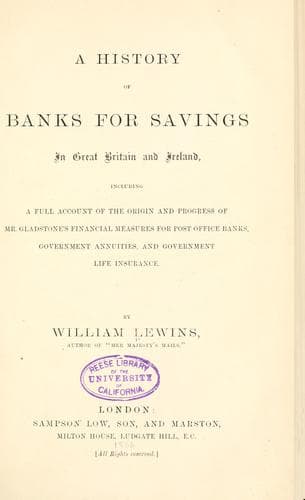
A History of Banks for Savings in Great Britain and IrelandLewins, William
History
A History of Banks for Savings in Great Britain and Ireland
Lewins, William
Postal savings banks -- Great Britain; Savings banks -- Great Britain
have laboured for twenty-five years brought him down, and with the
lack of his usual vigilance came detection and exposure.
This detection was effected by a Mr. Abrams, the clerk of the bank,
and it is from his evidence at the trial of his superior officer that
we learn the actuary's mode of operation. All the cases of fraud, it
seems, were identical in character, and were effected by means of
claims for withdrawals only. Every deposit reaching the bank was
properly received and properly accounted for. Like Haworth at
Rochdale, the Canterbury actuary carefully noted those who were
generally putting money into the bank, and seldom taking any out. In
the case of many of these depositors he had provided himself with
forged pass-books, with the deposit column always correct, but the
withdrawal side manipulated according as he himself wanted money.
Suppose any of the depositors came to the bank, to deposit or withdraw
a sum of money; they presented themselves to the actuary, who entered
in their proper bock the proper sum, but immediately substituted a
forged pass-book for the purposes of the bank. The ledger clerk
received a book from the actuary to copy into the ledger, and in this
way the books of the bank came to tally with the forged depositors'
books. All that was necessary to carry on the frauds was that the
actuary should keep a strict eye on the real pass-books of the
depositors, for the discrepancies would be patent, as it eventually
transpired, the moment the true books were seen. Sometimes the money
was obtained with less trouble. Greaves would occasionally give
himself notice that a depositor wished to withdraw a certain sum of
money (and this occurred several times in connexion with a person who
had deposited considerably, but never withdrawn any sum), and
represented that the money was entrusted to him "to keep." After the
_quasi_ notice had been acted upon, he would draw a cheque for the
money, and the amount would be entered in a false pass-book and copied
into the ledger; the luckless depositor, with her book safely by her,
being in entire ignorance of the whole transaction. The utter absence
of any control on the part of the managers and trustees, as
exemplified in such a mode of procedure, especially considering that
it came after the case of Bilston, the agitation of the last few
years, and the passing of the Act of 1863, reflected the greatest
discredit upon the honorary officials of the bank, though their
conduct subsequently went far to atone for their past neglect.
Public-domain text, read in full here on John Shaqi.
Reviews
Reviews
No reviews yet
Be the first to share your thoughts on this work.
Elsewhere in the archive
Join the Discussion
Join the discussion
Sign in to leave a comment or review.
Sign InorCreate an account