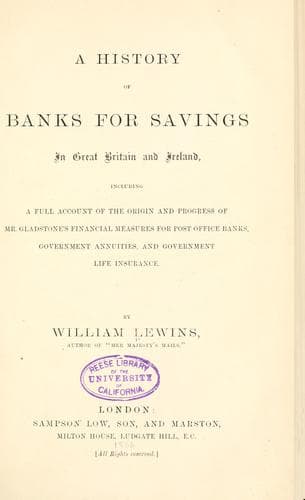
A History of Banks for Savings in Great Britain and IrelandLewins, William
History
A History of Banks for Savings in Great Britain and Ireland
Lewins, William
Postal savings banks -- Great Britain; Savings banks -- Great Britain
The case is described as having excited the most painful interest in
the city of Canterbury. The actuary, an old man of seventy, was tried
at the city quarter sessions in October, 1865; the trustees of the
bank prosecuting him on the charge of felony. The transactions were
again described, but only in brief, inasmuch as the prisoner pleaded
guilty. A strong memorial was presented, signed by many clergymen and
tradesmen, which, instead of asking for a mitigation of sentence
solely on account of his age and infirmity, put forward the following
extraordinary motive for interference: "The memorialists wish so far
to relieve his character from any undue opprobrium that may attach to
it, by declaring that the various business transactions they
individually have had with him, have always been conducted in an
honourable and satisfactory manner." At any rate, this questionable
memorial may at least serve to show the estimation in which he was
held by his fellow-townsmen. The prisoner was sentenced to six years'
penal servitude,--six years for each of the two indictments; but, on
account of his age, the years to run concurrently together.
The entire deficiency, when at length the whole of the accounts of the
bank were made up, was found to be 9,300_l._ Happily the depositors,
whom, so far as he knew, the actuary was mercilessly robbing, were
ultimately secured against loss. The surplus fund of the bank,
amounting to 3,500_l._, was applied to meet the case; the actuary gave
up property to the value of 1,700_l._; a gentleman who was his surety
for 400_l._ was called upon to pay that sum, and the remainder, about
3,000_l._, was subscribed by the trustees and their friends. The bank
was of course stopped on the defalcations coming to light, the books
were called in, and the trustees sought the advice of the Government
officials, as to transferring the business to the Post Office. The
stipulation in this case was, we believe, that the trustees should
make good the deficiency, and that then the business of the bank,
which was a large one, the deposits amounting to 150,000_l._, should
be handed over to the new establishment. Every effort was made by the
Post Office, in the way we have shown in the Bilston case, to stem the
tide of improvidence which generally sets in at such a time, and in
this case with great success.
Public-domain text, read in full here on John Shaqi.
Reviews
Reviews
No reviews yet
Be the first to share your thoughts on this work.
Elsewhere in the archive
Join the Discussion
Join the discussion
Sign in to leave a comment or review.
Sign InorCreate an account