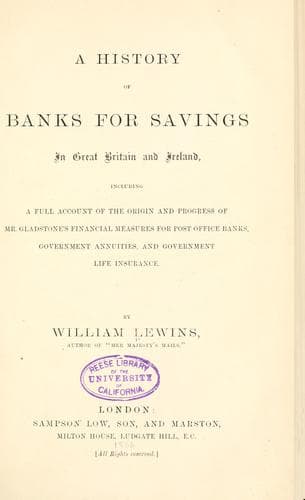
A History of Banks for Savings in Great Britain and IrelandLewins, William
History
A History of Banks for Savings in Great Britain and Ireland
Lewins, William
Postal savings banks -- Great Britain; Savings banks -- Great Britain
Great Britain can with justice, we think, lay claim to the original
establishment of the system of Savings Banks. One well-known
writer[11] on this and cognate subjects has traced them to
Switzerland, if not to Hamburg, at a time prior to any experiments
with them in this country; but from the best investigation we have
been able to make, the institutions in question were something very
different from Savings Banks as English people understand them,
dealing, as they did, in business more like the sale of deferred
annuities. The institution at Hamburg, which is said to have been
founded in the year 1778,--and which is interesting to readers of
history as being one of those whose coffers the First Napoleon swept
of their funds, thus giving it its death blow,--simply took the spare
cash of domestic servants and handicraftsmen, and granted annuities on
the members arriving at a certain age. No withdrawal of money was
allowed. In this country the first proposals for a bank for savings
were made in 1798 or 1799, according to the judgment of the reader as
to which of the two original schemes best deserves the name of Savings
Bank, or whether either of them is entitled to the honour. The two
persons whose names it is customary to speak of in connexion with the
earliest people's banks are those of the well-known Priscilla
Wakefield, and the Rev. Joseph Smith of Wendover. In the mind of each
of these estimable persons we think the question of becoming the
bankers for the poor around them was at first only a subordinate
measure, and quite auxiliary to other matters deemed of greater
importance. Mrs. Wakefield's scheme arose out of a well-meant anxiety
to better the condition of the weaker and more defenceless portions of
the community, an object to which she devoted much of her literary
ability, and was first started in 1799, for the benefit of women and
children in her own village of Tottenham, and under her immediate
superintendence. Members paying according to their age certain sums
per month became entitled to a pension after sixty years of age; in
case of sickness, four shillings a week; in case of extraordinary
misfortune a certain amount could be withdrawn; in case of death a sum
of money was allowed for the funeral. Honorary members paid
subscriptions, which went to meet deficiencies and current expenses.
In 1801 there was added, first, a fund from which loans were made to
those who had been members for six months; and second, a regular bank
for savings. The interest given in the latter case was the same as
that charged in the former, or five per cent. The clauses relating to
children were such as almost to entitle the founders to the honour of
being the originators of Penny Banks, if nothing else; juveniles were
encouraged to deposit their penny per month, which was kept for them,
along with interest, until such a time as the accumulation was needed
for apprentice fee, clothes, or such like object. The management of
Public-domain text, read in full here on John Shaqi.
Reviews
Reviews
No reviews yet
Be the first to share your thoughts on this work.
Join the Discussion
Join the discussion
Sign in to leave a comment or review.
Sign InorCreate an account