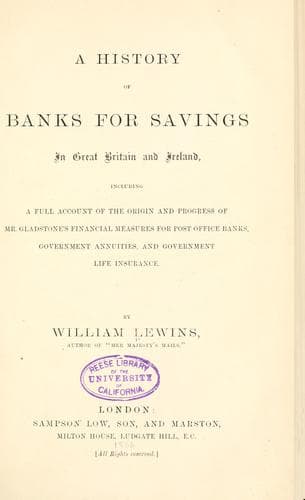
A History of Banks for Savings in Great Britain and IrelandLewins, William
History
A History of Banks for Savings in Great Britain and Ireland
Lewins, William
Postal savings banks -- Great Britain; Savings banks -- Great Britain
A statement was made before the Committee of 1858, that twenty-five
out of every hundred persons properly designated as of the industrial
classes were debarred from saving their money, even if inclined to do
so, from the want of convenient places of deposit; and the reader may,
we think, with the help of the above statistics, judge whether that
statement was at all an exaggerated one. "Is nothing to be said of the
inherent disposition of so many of the poorer classes to spend their
money, and the utter repugnance they feel to habits of frugality?"
says a doubting reader. Certainly. But how do the facts bear on this
matter? Let us take the returns of the four different counties already
alluded to as containing relatively the largest and the smallest
number of Savings Banks. In Berkshire, for every thousand persons an
amount equal to 2,479_l._ was accumulated in 1856; in Dorsetshire the
amount was 2,550_l._: on the other hand, in Lancashire, which we
described as most insufficiently served with banks, the amount per
thousand persons was only 1,562_l._, and in the West Riding of
Yorkshire but 1,266_l._ But we will take the case of a single bank to
show that the want of facilities was a most important element in the
want of progress; and to make the fact still plainer, we will go to
Lancashire itself. The Manchester Savings Bank has for long been one
of the best managed institutions in the kingdom, whilst elsewhere
there had been, as we have seen, the slowest growth, if not complete
stagnation in Savings Banks generally. The depositors in the
Manchester bank were nearly quadrupled in the twenty years now under
consideration, and no better test is required that these depositors
were of the right sort than the fact that, in 1860, 200,000_l._ lodged
at Manchester belonged to persons who could not even sign their
names.[140] These facts did not fail to strike the members of the
Committee of 1858, and Mr. J. Hope Nield, the eminent actuary of the
Manchester Savings Bank, was asked how he accounted for the fact of
this bank advancing so much more rapidly than any other. Mr. Nield
succinctly replied, "Only from the constantly increasing facilities
which it has been our constant endeavour to give." Mr. Nield
afterwards explained the facilities to which he referred. In many
banks, depositors had only a very short time for business, and then
perhaps they were restricted to one kind of business for one day,
another kind of business for another day. In the Manchester bank
depositors could go and do any kind of business whenever it was open.
There lay the distinction between "free" banks, and what were known as
banks on the "restrictive principle." In a restrictive principle bank,
of which there were an enormous number, withdrawals were made on one
day, deposits on another; new accounts could only be opened on a
certain day, additions could only be made to accounts on another
certain day. Then there was the notice to be given for withdrawing
money.
Public-domain text, read in full here on John Shaqi.
Reviews
Reviews
No reviews yet
Be the first to share your thoughts on this work.
Elsewhere in the archive
Join the Discussion
Join the discussion
Sign in to leave a comment or review.
Sign InorCreate an account