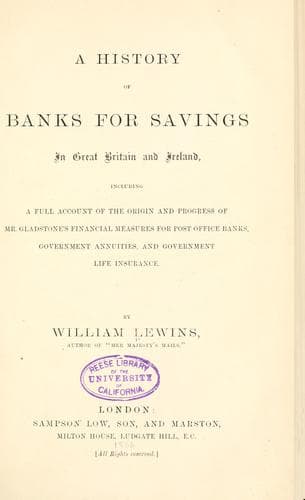
A History of Banks for Savings in Great Britain and IrelandLewins, William
History
A History of Banks for Savings in Great Britain and Ireland
Lewins, William
Postal savings banks -- Great Britain; Savings banks -- Great Britain
The more "free" the bank, the less notice: generally a week was
required; more often a fortnight was wanted; in many cases a month's
notice had to be given. "Whenever," said Mr. Nield, "a free bank could
be pitted against one on the restrictive principle, the increase in
the number of depositors in the former case would be found to be four
or five times as much as in the latter." This was shown in a clear
light by a striking illustration--also a somewhat amusing one: "Up to
1847," said Mr. Nield, "the late Venerable Archdeacon Brooks, of
Liverpool, would insist to the day of his death upon paying everything
himself in the Liverpool Savings Bank, and, as a consequence, the bank
was only open two days a month for the repayment of money. Deposits
were completely stationary there for many years, and cases were known
where persons went to the Manchester bank to open an account there,
and remitted money by post."
Whilst speaking of the Committee of 1858, we may here give the opinion
on this point of another gentleman, of whose career as an ardent and
laborious Savings Bank reformer we shall presently speak. Referring to
the absence of what he considered reasonable facilities in Savings
Banks, Mr. Charles William Sikes, of Huddersfield, expressed his
decided conviction that the present system "was inadequate to meet the
wants and wishes of the working classes of this country." When asked
(2,715) if he had made any calculation as to the extent to which the
savings of the working classes might reasonably be expected to amount
if the Savings Banks were thoroughly popular with them and were felt
to be perfectly safe, Mr. Sikes answered: "I think that if a knowledge
of Savings Banks becomes widely diffused (and the process is going
on), and if the reorganization of them receives the confidence of the
country, the average annual deposit, which now amounts to seven
millions, is so small a proportion of the aggregate income of the
working classes of this country, that instead of being, as it had
been, stationary, _with scarcely a fluctuation of two per cent. for
twenty years_, there will be a probable increase in the course of
three or four years, or perhaps a longer time than that, of two,
three, or five millions of money;--in other words, that the annual
deposit, instead of being seven millions, will get to eight, nine, or
eleven millions, in ten years. The income of the working classes is
fully 200 millions a year, and, with anything like provident and
sensible habits, thirty millions a year might be deposited in Savings
Banks."
* * * * *
Public-domain text, read in full here on John Shaqi.
Reviews
Reviews
No reviews yet
Be the first to share your thoughts on this work.
Elsewhere in the archive
Join the Discussion
Join the discussion
Sign in to leave a comment or review.
Sign InorCreate an account