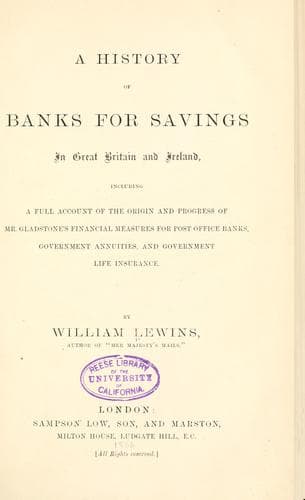
A History of Banks for Savings in Great Britain and IrelandLewins, William
History
A History of Banks for Savings in Great Britain and Ireland
Lewins, William
Postal savings banks -- Great Britain; Savings banks -- Great Britain
In February, 1807, Mr. Whitbread introduced his Poor Laws Amendment
Bill into the House of Commons, and went over the whole ground of the
condition and the wants and requirements of the working population in
an eloquent manner. That speech--which must have been of several
hours' duration--dealt with the past legislation on the subject, and
commented on the various steps which ought to be taken, over and above
the mere collection of poor-rates, to alleviate the condition of the
poor. After dwelling on the subject of national education, and hinting
at a mode such as was eventually brought into operation many years
afterwards, Mr. Whitbread went on to describe the want felt by the
poor of some safe and profitable investment for their earnings; "that
so few are found to make any saving may in a great degree be accounted
for by the difficulty of putting out the little they can raise at a
time." He described the action of Friendly Societies, and showed that
at that early period they were open to the same objections that are
now being continually raised against them. "Mr. Malthus,"[13] said Mr.
Whitbread, "had just proposed the establishment of county banks, but
he would go farther than Mr. Malthus, and extend his principle." It
seemed to him that there would be less trouble in his proposals than
in the less extensive proposals of Mr. Malthus.
Mr. Whitbread then went into the matter of his proposals under this
head, and we give his own words:[14] "I beg gentlemen not to start at
what I am about to suggest, which to many who hear me may be quite
new, but to afford it their cool and deliberate consideration. I would
propose the establishment of one great national institution, in the
nature of a bank, for the use and advantage of the labouring classes
alone; that it should be placed in the metropolis, and be under the
control and management of proper persons; that every man who shall be
certified by one Justice of the Peace to subsist on the wages of his
own labour shall be at liberty to remit to the Accountant of the
Poor's Fund (as I would designate it) any sum from 20_s._ upwards, but
not exceeding 20_l._ in any one year, and not more than 200_l._ in the
whole." He then proceeded to show how the money might be invested in
Government Stock, in the name of commissioners to be appointed, and by
this means interest would be allowed to depositors at the highest rate
possible. "The plan," added Mr. Whitbread, "will be more amply
detailed in the Bill itself, and such regulations are provided as
will, _with the intervention of the Post-office_, give ample
facilities to its execution. Gentlemen need not to be told that the
perfection attained in the management of that great machine is such as
to give the most easy and rapid means of communication with the
metropolis, much greater, indeed, than usually subsists between the
remote parts of any county and its capital town." Mr. Whitbread then
went on to say, that in addition to this form of investment, the same
Public-domain text, read in full here on John Shaqi.
Reviews
Reviews
No reviews yet
Be the first to share your thoughts on this work.
Join the Discussion
Join the discussion
Sign in to leave a comment or review.
Sign InorCreate an account