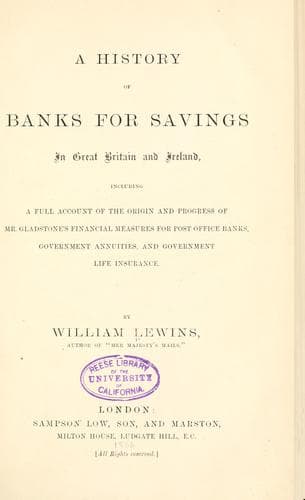
A History of Banks for Savings in Great Britain and IrelandLewins, William
History
A History of Banks for Savings in Great Britain and Ireland
Lewins, William
Postal savings banks -- Great Britain; Savings banks -- Great Britain
We can now come to veritable proposals. Though it is due to Mr. Sikes
to say that the fact of prior proposals, with the same object in view,
were either forgotten or only came to light for the first time after
he had publicly made and urged his plans on the country, it seems not
to admit of question that two gentlemen had been, quite unknown to him
or the public generally, over the same ground before him, and, whether
wisely or not we will not attempt to decide, had desisted from
pressing their plans after obtaining an adverse decision with regard
to them. So far as the Post Office is concerned, it is only fair to
say that the authorities up to quite a recent period have had their
hands sufficiently full in completing the plan of Penny Postage Reform
which, for several years after the passing of the Act of 1839, was
almost held in abeyance; and that, inundated with crude and
undeveloped schemes, it was requisite that a plan in which so much was
involved should be well matured, and go weighted with the stamp of
public approval. Whether, however, the Post Office system was prepared
so early as 1851,--the date of the earliest proposal,--to undertake
Savings Bank business, is a question which, considering the transition
state in which it then was, admits of some doubt.
In 1852, the Rev. George Hans Hamilton, the Vicar of
Berwick-upon-Tweed, and now Archdeacon of Lindisfarne, proposed
through his relative, Mr. G. A. Hamilton of the Treasury, a national
system of Savings Banks to be worked by means of the Post Office,[160]
which it is but justice to say presents many, if not most, of the
features of the plan eventually produced. Mr. Hamilton met with
varying success; his proposals were not taken up warmly, but were
understood by him to present difficulties which might ultimately be
overcome. Had this gentleman persevered in the advocacy of the scheme
which he propounded, or had he had the good fortune, to have fallen on
more favourable times, with Mr. Gladstone as Chancellor of the
Exchequer, there can be little doubt that his plan would have been
cordially taken up and his name ever associated with it. As it was,
his exertions were recognised by Mr. Gladstone when he came to deal
with the matter, that gentleman referring on one occasion to the
valuable suggestions he had made. It should be added, that Mr.
Hamilton has, since the plans came into operation, urged a
modification of one of its features (to be referred to hereafter), and
it is little to say, considering the value and the shrewdness of his
original suggestions, that he is well entitled to be heard on the
point.
Public-domain text, read in full here on John Shaqi.
Reviews
Reviews
No reviews yet
Be the first to share your thoughts on this work.
Elsewhere in the archive
Join the Discussion
Join the discussion
Sign in to leave a comment or review.
Sign InorCreate an account