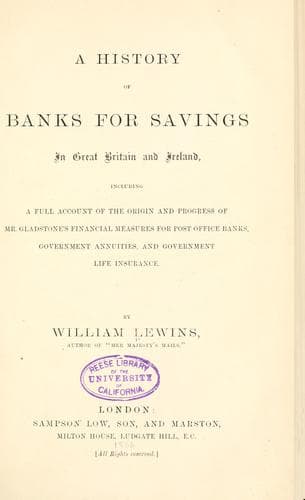
A History of Banks for Savings in Great Britain and IrelandLewins, William
History
A History of Banks for Savings in Great Britain and Ireland
Lewins, William
Postal savings banks -- Great Britain; Savings banks -- Great Britain
The other gentleman who somewhat later than Mr. Hamilton, and quite
unknown to him, made proposals to the same effect, was Mr. John
Bullar, the eminent counsel, of the Temple. Mr. Bullar himself informs
us that his attention was attracted to the subject by observing the
working of a Penny Bank at Putney, which was established in the year
1850. Being a member of the Committee of this bank, he was led to
think much over "the then existing system of Savings Banks, and how
some of the defects of the system could be remedied." After thinking
the matter well over, he drew up the memorandum which we give
_verbatim_:--
It is admitted that the present system of Savings Banks is
defective, and that a new system is much wanted.
Among the defects of the present system are:--Want of
perfect security to depositors: risk of loss to trustees
by defaulting clerks, and want of opportunities for the
labouring classes to make deposits as soon as they have
anything to deposit.
Many of the present Savings Banks are only opened for two
or three hours once a week; so that those who would
deposit in them are forced to be their own bankers during
the rest of the week, and are exposed to the constant
temptation of spending what they have in their pockets;
the particular temptation from which Savings Banks were
intended to relieve them.
In order to give perfect security to depositors, they
ought to have the security of the nation.
The establishment of Savings Banks for the whole of the
labouring classes being a matter of national importance,
they ought to be a national, and not merely a
philanthropic institution.
In order that they may confer the greatest amount of
benefit on the labouring classes, they ought to be open
during the whole of every working day.
The principle of a National Savings Bank as a National
institution is already admitted in the Savings Banks for
the Army, the Navy, and the Mercantile Marine.
The principle of Government acting as Banker for the
Nation is already admitted in the Money Order department
of the Post Office.
That department is, in fact, a National Bank. It receives
money from all comers; it retains the money for divers
periods, from four-and-twenty hours to several weeks; and
it pays the money to those who are entitled to demand it.
It would be a mere extension in point of detail if that
department received more money from more comers, retained
the money for longer periods, and paid it out with the
addition of interest upon it.
It is therefore suggested that the Money Order department
of the Post Office should be made a National Savings Bank,
investing the deposits in Government securities, paying a
moderate rate of interest (say two and a half per cent.)
and paying interest only on round pounds deposited for not
less than a quarter of a year.
Public-domain text, read in full here on John Shaqi.
Reviews
Reviews
No reviews yet
Be the first to share your thoughts on this work.
Elsewhere in the archive
Join the Discussion
Join the discussion
Sign in to leave a comment or review.
Sign InorCreate an account