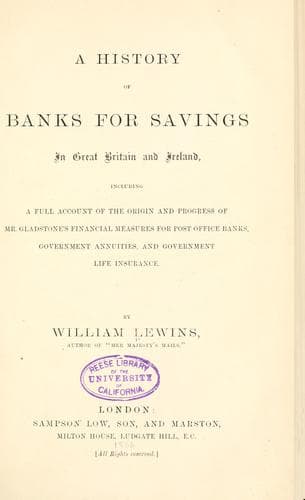
A History of Banks for Savings in Great Britain and IrelandLewins, William
History
A History of Banks for Savings in Great Britain and Ireland
Lewins, William
Postal savings banks -- Great Britain; Savings banks -- Great Britain
The trustees of existing Savings Banks should be
authorized (except so far as any depositors might object)
to transfer their deposits to the department.
In all probability the deposits with the department would
amount to at least thirty millions in the course of a year
or so; and at the present price of Consols, this would
give to the Post Office about 200,000_l._ beyond the
interest which they would have to pay to the depositors.
If this would not meet the expenses, the rate of interest
might be 2_l._ per cent., giving to the department an
additional 150,000_l._ a year.
The principle being admitted, there would be no
insuperable difficulty in arranging the details.
JOHN BULLAR.
_Temple, November 8, 1856._
This memorandum was written in November, 1856. Mr. Bullar describes
that at that period he was too much occupied to enter into the matter
so fully as was necessary, or to agitate by means of the press for
some such scheme; but Mr. Bullar's friend, Mr. Joseph Burnley Hume
(eldest son of the late Mr. Joseph Hume, M.P.), who had some leisure
at command, and perhaps some of his father's desire to achieve an
amendment of the Savings Bank system, undertook to bring the matter
forward in the proper official quarters. He early saw Mr. Frederic
Hill, who was in charge of the Money Order department of the Post
Office, and learned from him that the same scheme had already been
suggested to the Post Office, and rejected after full consideration. A
month afterwards Mr. Hume saw the Duke of Argyll, who was then
Postmaster-General, and received a courteous hearing from him. The
Duke also said that the Post Office had had the question, or something
like it, before them, and that he thought the Chancellor of the
Exchequer still had something of the kind under consideration; but
gave no definite reply. Subsequently he saw Sir Alexander Spearman,
the Comptroller of the National Debt Office, and Mr. Tidd Pratt. "He
gathered from them," to use Mr. Bullar's own words, "that they were
with him in principle, but regarded the proposed Money Order
department as visionary, and that the Government had under
consideration a different scheme, which they preferred."[161] Having
in this way met with enough discouragement to hinder them--or any
other person who might be cognizant of the proceedings that had been
taken--from going further, they dropped any further steps to bring
about this desirable change.
Public-domain text, read in full here on John Shaqi.
Reviews
Reviews
No reviews yet
Be the first to share your thoughts on this work.
Elsewhere in the archive
Join the Discussion
Join the discussion
Sign in to leave a comment or review.
Sign InorCreate an account