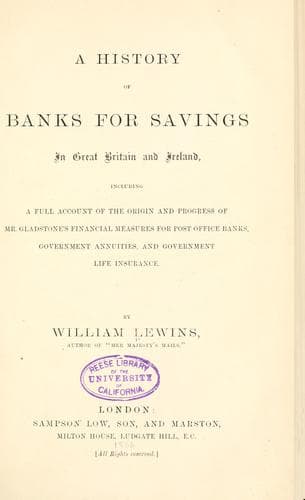
A History of Banks for Savings in Great Britain and IrelandLewins, William
History
A History of Banks for Savings in Great Britain and Ireland
Lewins, William
Postal savings banks -- Great Britain; Savings banks -- Great Britain
He then asked if the stagnation in the
business of Savings Banks was not to be traced to the non-increase of
their number, their absence in many very populous localities, the
slight accommodation given, and the arbitrary routine, and
restrictions imposed. If Savings Banks were worth anything, were they
not worth improving? And would not those supplementary banks do much
themselves, and very probably cause an improvement in existing ones?
Having matured his plan in June, 1859, Mr. Sikes communicated it to
Mr. Edward Baines, the member for Leeds, in the form of a printed
Letter; and this gentleman, well known for his wide sympathy with the
industrious classes, after studying its details, expressed his warm
approval of the project, and engaged to bring it under the notice of
Sir (then Mr.) Rowland Hill, the Secretary of the Post Office. That
there was now no indisposition--if ever there was--on the part of the
authorities to such a measure is evident from the reception it met
with at their hands, as shown by the letter below.[163] Encouraged to
persevere, Mr. Baines and Mr. Sikes had an interview with the
Secretary and some of the principal heads of departments at the Post
Office, when the draft of a plan was read to them for working such a
measure, the official gentlemen concerned assuring them that this
might be done "with great ease and simplicity."
The next step which Mr. Sikes took was to place himself in
communication with the Chancellor of the Exchequer; and as a
preparatory step, he printed his scheme afresh, extending it somewhat,
in the form of a Letter to Mr. Gladstone. The communication was met by
a cordial acknowledgment, in which that right hon. gentleman promised
his best attention in examining the scheme, not only on account of the
interest attaching to the subject, but "of the authority with which it
was invested," in proceeding from the quarter whence it did. The
letter was then given to the public, and immediately attracted general
attention, and warm expressions of approval. It was read before the
Social Science Association which met in Bradford in the autumn of that
year, Lord Brougham having also mentioned the matter in his inaugural
address. For a few weeks it was a common subject of discussion, public
opinion being somewhat divided as to its advisability as well as
practicability. Several Liberal newspapers, however, went warmly into
an advocacy of the principles of the measure, if not of the measure
itself; and in the early part of November, 1859, the members of the
Huddersfield Chamber of Commerce strengthened the hands of their
townsman, by passing an unanimous sentence of commendation upon it;
and not only so, but they resolved to send Mr. Sikes's tract to all
the Chambers of Commerce in the kingdom, recommending them to support
the plan, which several of them eventually did.
Public-domain text, read in full here on John Shaqi.
Reviews
Reviews
No reviews yet
Be the first to share your thoughts on this work.
Elsewhere in the archive
Join the Discussion
Join the discussion
Sign in to leave a comment or review.
Sign InorCreate an account