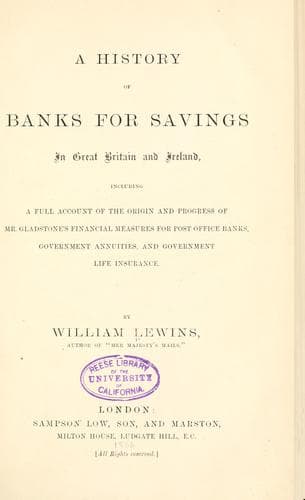
A History of Banks for Savings in Great Britain and IrelandLewins, William
History
A History of Banks for Savings in Great Britain and Ireland
Lewins, William
Postal savings banks -- Great Britain; Savings banks -- Great Britain
During the interval, when the ball was kept rolling in this manner,
Mr. Gladstone had amply fulfilled his promise to give the subject his
best attention, as sufficiently appears from a letter which, belonging
now to the history of Post Office Savings Banks, we append below.[164]
Expressions of opinion on the advantage of some such scheme still
continued to be sent to Mr. Gladstone and Mr. Sikes, which must have
encouraged them both to persevere, and which made it very apparent
that the public had made up its mind not to allow the matter to
drop--at any rate, quietly.
The most important petitions sent to the Chancellor of the Exchequer
emanated from Liverpool, Leeds, and York; but a resolution passed by
the Dublin Statistical Society, presided over by Dr. Whately, the late
Archbishop of Dublin, and signed by Dr. W. Neilson Hancock as
secretary, deserves special notice, were it only for the weight
attaching to Dr. Hancock's own name.[165] In answer to these and
similar memorials, Mr. Gladstone seems to have generally replied that
the matter was under his most careful consideration; "that he received
with cordial satisfaction this expression of opinion, proceeding from
persons well qualified to judge, and that he earnestly hoped it may be
practicable to frame a plan by which the objects in view may be
extensively attained."
And now the curtain may be said to have fallen upon the scheme, and
for fully twelve months it is beyond the public gaze, and entirely
beyond public criticism. We find that now and then Mr. Sikes was busy
during the period in answering objections to his plan, with as much
energy and good sense as he had previously displayed in his advocacy
of it, before he had the good fortune to enlist the services of Mr.
Gladstone in its behalf. Now, however, it may be said to have passed
out of his hands, and to have fallen into those of others, who, no way
averse or unfriendly to his project, saw that it would be necessary
largely to remodel it, in order to make it fit into the machinery, (of
the working of which Mr. Sikes was necessarily ignorant,) upon which
it would have to be engrafted. Furthermore, among much approving
criticism of the scheme, there had been not a little feeling exhibited
among influential organs of the public press, that Mr. Sikes had not
gone far enough in his proposals, and that on some points the details
were not nearly so liberal as they ought to be made. As an ardent
friend to the Savings Bank system, Mr. Sikes had doubtless well
considered the objections which Savings Bank managers were likely to
urge; and, to stave off opposition on the part of many of his friends,
had apparently sacrificed a detail here and there in a matter where
boldness of action was most essential to success. If one thing is more
clear than another in the history of our great reforms, it is that the
projector who plunged right into the stream was always surer of
ultimate success than he who paddled about in the shallows, or kept as
Public-domain text, read in full here on John Shaqi.
Reviews
Reviews
No reviews yet
Be the first to share your thoughts on this work.
Elsewhere in the archive
Join the Discussion
Join the discussion
Sign in to leave a comment or review.
Sign InorCreate an account