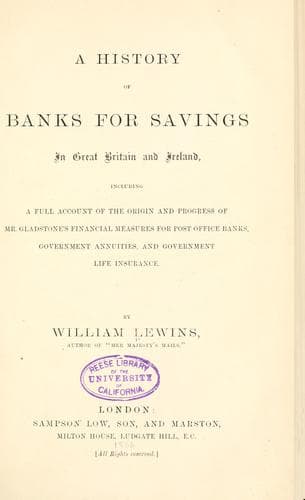
A History of Banks for Savings in Great Britain and IrelandLewins, William
History
A History of Banks for Savings in Great Britain and Ireland
Lewins, William
Postal savings banks -- Great Britain; Savings banks -- Great Britain
close as possible to the brink. In this way, therefore, it seems to
have come about that not only must modifications be made, but steps
must be taken to perfect the plan, and present it in such a shape as a
measure of reform as should silence cavil and complaint. Twelve months
for such a work might seem long--might, indeed, be unnecessary; but
few will say that the scheme,--so much remodelled as fairly to be
considered a new one, did not amply atone for the delay.
The task of adopting Mr. Sikes's proposals just as they originally
stood, and which proposals the Post Office authorities had generally
acquiesced in, seems to have been abandoned on account of the
practical difficulties which stood in the way; one of which Mr.
Gladstone indicated in the letter we have already given. The object
now, therefore, was to originate a mode of working altogether
independent of Mr. Sikes's plan, in which the desirable modifications
to be made in Mr. Sikes's scheme should also be introduced. Before,
however, we show how this was eventually accomplished, it is necessary
to say in what these important modifications consisted.
1. Mr. Sikes's scheme was proposed to be worked by a
Commission who should preside over a central bank and
employ the agency of the Post Office. Such a division of
authority would have been unprecedented, and must have led
to confusion and great expense, if even it could have been
so arranged.
2. The Commissioners were to have been empowered to
receive Money Orders as deposits and acknowledge them in
the form of an expensive description of "Interest Notes."
The Money Orders and the "Notes" themselves would have
required all the surplus interest to have been expended
upon them, and there would have been little chance of the
scheme turning out self-supporting.
3. Mr. Sikes proposed to open only 1,527 Money Order
Offices as Savings Banks. He proved at great length that
the system he proposed was not only the best, but the
cheapest; yet at the solicitation, we believe, of several
Savings Bank actuaries, he did not go the length of
including any town where provision had been made for
provident people. This, of course, restricted the
inhabitants of 600 towns to the dearer mode of operation,
though the cheaper one was shown to hold out anticipations
of producing by far the best article. Such considerations
could not, we should imagine, weigh with the Post Office
when once the matter was taken in hand, and no arbitrary
test of the above nature could ever have been entertained.
Public-domain text, read in full here on John Shaqi.
Reviews
Reviews
No reviews yet
Be the first to share your thoughts on this work.
Elsewhere in the archive
Join the Discussion
Join the discussion
Sign in to leave a comment or review.
Sign InorCreate an account