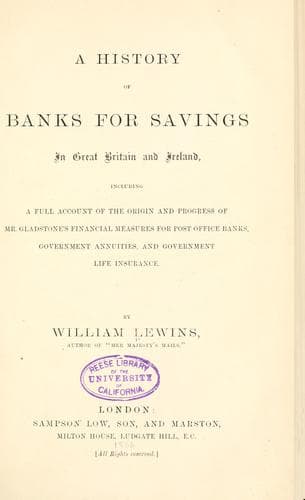
A History of Banks for Savings in Great Britain and IrelandLewins, William
History
A History of Banks for Savings in Great Britain and Ireland
Lewins, William
Postal savings banks -- Great Britain; Savings banks -- Great Britain
under the arrangements of the measure, he would answer for it that the
Post Office machinery should be applied carefully and gradually--the
most neglected districts to be supplied first. Mr. Gladstone then went
into the object and details of the measure. His proposal was that the
Post Office should receive and return deposits, with interest, in the
same way as Money Orders were dealt with, charging merely a fair
remunerative price for the work performed. In one respect the
principle upon which the new banks would be founded would be
essentially different from that of the old ones. The latter had been
established with the notion that the State might very fairly offer to
the labouring classes a certain premium by way of inducing them to
make deposits; but while he was far from desiring to cast any censure
upon the principle, he did not deem it right in the present case to
hold out to depositors the expectation of obtaining any high rate of
interest. He proposed to give a rate of interest 10_s._ less than that
given by the ordinary banks, with a proviso that it might be increased
to that rate, if found necessary, "and within certain limits."
Mr. Gladstone provided an ample set-off against a less remunerative
return for the money, in the security which he now proposed to give
for its safe custody. The responsibility of the State, on account of
Savings Bank money had always been a subject of the greatest
difficulty; he argued on this occasion with perfect reasonableness, as
many of his predecessors in office had argued before, that the State
could only be responsible for the acts of its own officers; and as up
to this time no plan had been devised by which the State could
participate in all the proceedings of Savings Banks, it was impossible
to carry out the principle of a perfect Government guarantee. What,
however, could not be done with the old banks, might and should be
done with the new. In his proposals there was something so essentially
different from anything they had been accustomed to, that a Government
guarantee was an easy and a possible thing. The money would be
received by Government officials: it would be invested by these
servants in Government securities; and it would be inexcusable to
refuse a Government guarantee for the full amount. Hence the motion
which he had made. The only effective form which this guarantee could
take was the technical one, to pass a resolution providing that if any
difficulty arose in the means of meeting the lawful demands of lawful
depositors, that difficulty might be met by a charge on the
Consolidated Fund. Mr. Gladstone, in concluding, hoped honourable
gentlemen would not be alarmed at his resolution, as he would
expressly state then that the great basis of this new arrangement was
that it should be self-supporting.[169]
Public-domain text, read in full here on John Shaqi.
Reviews
Reviews
No reviews yet
Be the first to share your thoughts on this work.
Elsewhere in the archive
Join the Discussion
Join the discussion
Sign in to leave a comment or review.
Sign InorCreate an account