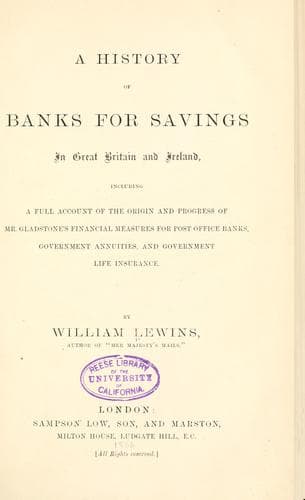
A History of Banks for Savings in Great Britain and IrelandLewins, William
History
A History of Banks for Savings in Great Britain and Ireland
Lewins, William
Postal savings banks -- Great Britain; Savings banks -- Great Britain
_Mr. Francis Crossley_ (now Sir Francis) went over the ground of the
very deficient means of investment for the surplus cash of the poor,
producing statistics of a kind with which our readers are now
sufficiently familiar, and stated that it was impossible to
over-estimate the advantages which must accrue to certain classes in
the country from the carrying out of the proposals which had been
submitted to them. "A great deal of fault," said Mr. Crossley, "had
been found with the improvidence of the working people in not saving
money, but let them first see what the Government had done to help
them. The State provided beer-shops in every street for working men to
spend their money in as fast as they earned it; but hitherto he did
not think it had been sufficiently forward in giving them facilities
for saving their money." He then alluded to the fear which working men
had of the ordinary banks, from their masters being connected with
them, and who from that connexion would be able to see what they were
able to save. "Under the Postmasters, this would, or should be,
different." The country was indebted to Mr. Gladstone for the amount
of attention he had bestowed on the proposals of Mr. Sikes. Mr.
Crossley concluded: He "did not think Government ought to seek to make
a profit on the new business; nor did he think they ought to lose by
it. The working classes of the country did not want charity, they only
wanted a fair field and no favour, and it seemed that at length they
were about to get it. If at any time the rate of interest could be
raised without loss or inconvenience, he hoped it would be done."
_Colonel Sykes_ said that no praise could be too high for anything of
this sort, which tended to induce the working classes to lay by
against a bad time. He contented himself with referring to two or
three subjects connected with the mode of working the scheme. _Mr.
Arthur Kinnaird_ thought the scheme simple and practical. He "heartily
congratulated the Chancellor of the Exchequer on having at last
succeeded in one of the fondest hopes of his heart--that of creating a
two and a half per cent. stock." Mr. Gladstone at once demurred to
this, and stated that he had no notion of establishing a national
bank. The money which came into the hands of Government by means of
the bill would simply be applied as under the existing Savings Bank
law. Mr. Gladstone, in closing the debate, took the opportunity of
referring to Mr. Sikes, "who had devoted a great amount of labour to
the subject. He felt greatly indebted to him. At the same time, the
bill was not intended to embody altogether Mr. Sikes's plan, though
this was a matter of detail into which he would not then enter."
Public-domain text, read in full here on John Shaqi.
Reviews
Reviews
No reviews yet
Be the first to share your thoughts on this work.
Elsewhere in the archive
Join the Discussion
Join the discussion
Sign in to leave a comment or review.
Sign InorCreate an account