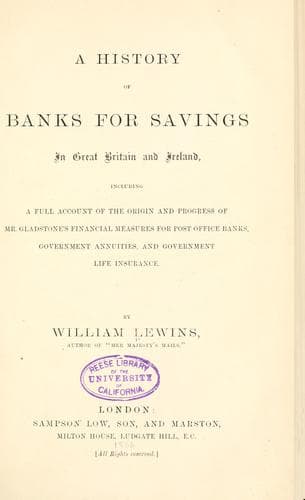
A History of Banks for Savings in Great Britain and IrelandLewins, William
History
A History of Banks for Savings in Great Britain and Ireland
Lewins, William
Postal savings banks -- Great Britain; Savings banks -- Great Britain
Three days after this discussion the Post Office Savings Banks bill
was introduced into the House of Commons _pro formá_ by Mr. Massey,
the Chancellor of the Exchequer, and Mr. F. Peel. Mr. Sotheron
Estcourt on this occasion commented on the importance of the bill, and
objected to a first reading without an explanation of its provisions;
all that was known of it being that the Government were about to frame
on its provisions banks of deposit on a gigantic scale, and thus by a
merely formal proceeding were about to lay the foundation for very
important consequences.
The Chancellor of the Exchequer moved the second and principal reading
of the bill on the 18th of March, 1861. _Mr. Estcourt_, whose intimate
acquaintance with such subjects made his remarks carry considerable
weight, made a long speech. He first expressed his doubts whether the
persons employed by the Post Office would ever be able to perform the
additional and important duties which would be assigned to them.
Government were undertaking a great risk. "No doubt the plan would
become popular, for several reasons; the Post Office Banks would
absorb not only all future deposits, but also a great part, if not
all, of those which had been made in the existing banks
themselves."[170] It would be for the House to decide whether this
result would be good or bad, or what could be done that the two kinds
of banks need not come into collision. Mr. Estcourt threw out several
hints as to how this might be done. They might, for example, limit the
sum to be received at post offices, so that the new might not come
into competition with the old class; or they might dovetail the new
system into the old, by making the Post Office Banks auxiliary and
subsidiary to the existing banks. Much had been done in the way of
trying to amend the constitution of the old class of banks, without
effect; and he thought that, looking to the probable result of the new
arrangement, it would be far better to look the evil fairly in the
face, and supersede at once the old by the new kind of banks, or at
least say which of the two ought to be retained. This speaker further
apprehended that the Post Office Banks would not take root in the
villages, where they were most wanted, and would be almost exclusively
confined to the towns where they were least needed, and where they
would overthrow the existing Savings Banks by drawing away their
deposits. Though Mr. Estcourt seemed to feel strongly on the different
points touched upon by him, he concluded by stating that he should not
oppose the second reading of the bill. _Mr. W. E. Forster_ said, in
his opinion the scheme would provide good Savings Banks where none now
existed, and, a very desirable matter, _safe_ banks where they did
exist. He thought it was not possible that the one class of banks
could dovetail into the other; and if it was, it was not desirable.
Where Government took the responsibility, it ought to have the
control. _Mr.
Public-domain text, read in full here on John Shaqi.
Reviews
Reviews
No reviews yet
Be the first to share your thoughts on this work.
Elsewhere in the archive
Join the Discussion
Join the discussion
Sign in to leave a comment or review.
Sign InorCreate an account