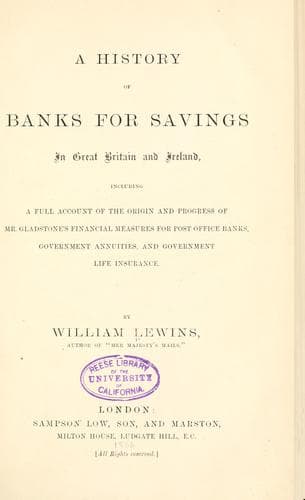
A History of Banks for Savings in Great Britain and IrelandLewins, William
History
A History of Banks for Savings in Great Britain and Ireland
Lewins, William
Postal savings banks -- Great Britain; Savings banks -- Great Britain
In November, 1815, the Provident Institution of Southampton was
established, principally through the exertions of the Right Hon.
George Rose, who was appointed president, and who soon afterwards
wrote an account of the undertaking.[17] The exertions of Mr. Rose on
behalf of savings banks will frequently require to be spoken of in
subsequent pages. The Southampton Bank was an improvement on the Bath
institution, having copied several of the details of the bank at
Edinburgh. The average rate of interest given was four per cent.
Notice had to be given for withdrawing deposits. One regulation, new
at that period, which was a suggestion of Mr. Rose, empowered the
officiating clergyman or other responsible person, in adjacent
parishes, to receive sums "on account of the institution," and remit
them to the treasurer at Southampton. It was stipulated, however--and
this had an ill effect upon the public, though the proviso was by no
means unreasonable in itself--that the institution should not be
answerable for the money until it absolutely reached the office. We
will here refer to two other original English savings banks, quite
equal in importance to those of Bath or Southampton. The Exeter
Savings Bank, since better known as the Exeter and Devon Bank, was
established in 1816, principally through the exertions of Sir John
Acland, one of the county members. The rules of this bank limited the
amount which could be deposited to 50_l._ in the first and second
years, and 25_l._ in any succeeding year. The distinguishing feature
about the Exeter bank was the application, attended with much greater
success, of the Southampton plan of rural or branch banks. In 1817,
there were sixty of these branch banks, all contributing sums to the
parent bank through village clergymen, who acted as the agents. The
plan only entailed a trifling expense for printing, postage, &c., and
even these expenses were paid out of a fund raised by voluntary
contributions. At the date of the first enactment relating to savings
banks, this bank had 946 depositors, who had paid in 14,525_l._ in
1,380 deposits. The interest given was at the rate of four per cent.
Within the two years of which we have spoken, only 984_l._, or about a
fifteenth-part of the deposits, were paid as withdrawals.
The original Hertford Savings Bank was a charitable concern, after the
fashion of Mr. Smith's at Wendover. "The Sunday Bank," as it was
called, was established about the year 1808, by the vicar of the
place, the Rev. Thomas Lloyd. Sums of from sixpence to two shillings
were received by the benevolent pastor from his poorer parishioners
after morning service on Sundays, and in this way about 300_l._ a year
was invested between 1808 and 1816. The money did not accumulate from
year to year, but was repaid on New Year's day, with the addition of
_ten_ per cent. interest, which the vicar was able to give by the help
of some charitable funds at his disposal.
Public-domain text, read in full here on John Shaqi.
Reviews
Reviews
No reviews yet
Be the first to share your thoughts on this work.
Join the Discussion
Join the discussion
Sign in to leave a comment or review.
Sign InorCreate an account