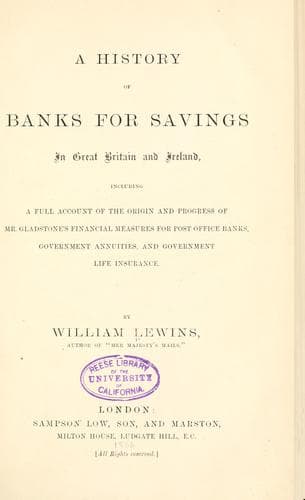
A History of Banks for Savings in Great Britain and IrelandLewins, William
History
A History of Banks for Savings in Great Britain and Ireland
Lewins, William
Postal savings banks -- Great Britain; Savings banks -- Great Britain
No time was lost in bringing the bill forward in the House of Lords.
It was read a first time on the 15th of April, and a second time on
that day week. The conduct of the bill in the Lords was naturally
committed to the Postmaster-General, Lord Stanley of Alderley. On this
occasion his lordship went over[173] the ground covered by the
bill--the insufficiency in number, and the inadequacy of accommodation
of existing banks, and the insecurity as regards repayment until the
money had actually reached the hands of the National Debt
Commissioners. Lord Stanley added that Savings Banks had by no means
increased in number in proportion to the population, or to the
increase of the money circulating among the working classes. He
adduced several facts and a quantity of statistics on this head
similar to those which we have already given to the reader. From these
facts it was obvious, that when a working man formed a good intention
to invest his small savings, there was a great danger that he would
spend his money, if there were no means of his depositing it, or if he
could not do it comparatively easily. He then spoke of the losses
caused by the failures of Savings Banks. Referring to Mr. Whitbread's
proposals in 1807, Lord Stanley stated that this measure was very like
the scheme then proposed, which actually passed through the House of
Commons in that year; that Mr. Sikes had originally proposed something
similar in an admirable letter to Mr. Gladstone; and that the
Government, with the assistance of two able gentlemen in the Post
Office department, had matured the present plan, which he proceeded
very clearly to describe. Lord Stanley, in concluding, said it was
somewhat remarkable that nine-tenths of the depositors in Savings
Banks were domestic servants and clerks, and that only one-tenth
belonged to what are usually known as the "working classes;" yet large
numbers of these latter are in receipt of wages far exceeding the
incomes of many who possessed Savings Bank accounts.[174] He hoped
that working men, when they received their wages, would be induced,
before going home, to invest a portion of them at the receiving houses
they would pass; if so, the result to them and the country could not
but be highly beneficial. The banks must be looked upon as an
experiment. If an extension should be demanded, it could only be by
reason of the greater security and greater facilities they would
offer.
Public-domain text, read in full here on John Shaqi.
Reviews
Reviews
No reviews yet
Be the first to share your thoughts on this work.
Elsewhere in the archive
Join the Discussion
Join the discussion
Sign in to leave a comment or review.
Sign InorCreate an account