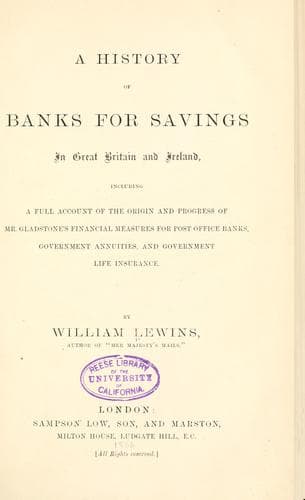
A History of Banks for Savings in Great Britain and IrelandLewins, William
History
A History of Banks for Savings in Great Britain and Ireland
Lewins, William
Postal savings banks -- Great Britain; Savings banks -- Great Britain
Lord Colchester, an ex-Postmaster-General, admitted the merits of the
plan, but doubted the ability of the Post Office officials to carry on
the work in every town. Among the Lords, however, the strongest and
bitterest opponent of the measure was Lord Monteagle of Brandon (once
Chancellor of the Exchequer as Mr. Spring Rice).[175] He made a long
speech on this occasion. He thought it was wrong to establish new
banks, or to make them rest on the deficiencies of the old ones,
inasmuch as it was easy to improve the latter. He went into the
history of Savings Banks, and endeavoured to show that their progress
up to 1850, (a fact which no one disputed,) had been far from slow.
As, however, it was the period principally between 1850 and 1860 when
they were most stationary, this was the time with which he should have
dealt. He expressed an opinion that the Post Office would not be equal
to the work. He strongly urged the inexpediency of giving increased
funds to the Chancellor of the Exchequer, with which to speculate. And
this measure would tend to destroy the healthy feeling which was
growing up between the higher and the lower classes, through the
medium of Savings Banks. Not only did the higher classes give their
time and energy to the work of Savings Banks, but they gave their
money too; and Lord Monteagle was unlucky enough to cite the case of
several noble lords who paid a thousand pounds each to atone for their
neglect in connexion with a Hertfordshire Savings Bank, and the fraud
there, which we have previously described at length. "Such was the
spirit," triumphantly exclaimed the noble lord, "which this bill
proposed to crush." Not less unfortunate was Lord Monteagle, as the
result has proved, in his endeavour to be amusing and prophetic. "The
only comfort," said he, "which I have derived from the speech of the
noble lord who moved the second reading, was his assurance that the
measure was to be of an _experimental_ character." Under such
circumstances he would not trouble the House with a division, as he
would await without much anxiety the result of the "experiment!" Next
year, they would see whether the working of the new system would
compare with that "which for nearly half a century had been the glory
of England, and had served as a model for all Europe." Lord Redesdale
also strongly opposed the bill, but he did not bring to its
consideration much of the practical knowledge of the preceding
speaker. He "frankly owned" that, from what he understood "would be
the manner of keeping the accounts, they would soon get into a state
of confusion, out of which extrication would be almost impossible."
From the confusion of the above sentence, it is not impossible that
the attempt to understand the mode of keeping the accounts had
confused the speaker. Curiously, too, the same speaker objected to one
of the most convenient clauses of the bill. He called the proposed
mode of transfer of deposits from one bank to another, an unnecessary
Public-domain text, read in full here on John Shaqi.
Reviews
Reviews
No reviews yet
Be the first to share your thoughts on this work.
Elsewhere in the archive
Join the Discussion
Join the discussion
Sign in to leave a comment or review.
Sign InorCreate an account