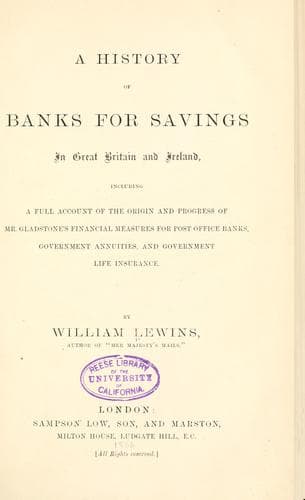
A History of Banks for Savings in Great Britain and Ireland — John Shaqi
A History of Banks for Savings in Great Britain and IrelandLewins, William
History
A History of Banks for Savings in Great Britain and Ireland
Lewins, William
Postal savings banks -- Great Britain; Savings banks -- Great Britain
Henry Duncan, who was the son of a Dumfriesshire clergyman, was born
at Lochrutton manse, in that county, in the year 1774. At the age of
twenty-five he too was ordained a clergyman, and appointed to the
charge of the parish of Ruthwell, a remote locality in the same
county. When very young, it is said, he showed remarkable powers of
mind; and it appears he early exercised them in writing for the young,
with whom he was an especial favourite. Before he was thirty he had
made great progress in geology, and a book he published on the subject
when he was about that age gained him the friendship of Dr. Buckland
and Mr. Sedgwick. Perhaps, however, he showed most zeal during all the
periods of his life in the prosecution of schemes for the benefit of
the poor and distressed around him; and his manse in this way, lonely
as it was, and far from the busy haunts of men, soon became a place of
resort to much of the young and remarkable talent to be found in that
part of Scotland. David Brewster, and James Grahame, the Sabbath bard,
Dr. Chalmers, and Dr. Andrew Johnson, were frequent visitors beneath
his roof; Robert Owen, then an amiable enthusiast in the walks of
philanthropy; Thomas Carlyle, a young man who had not then emerged to
fame; Robert McCheyne, and many others who subsequently rose to
eminence, were friends of the village pastor, and frequently met to
talk over with him different schemes of practical benevolence. "Few,
indeed," says his biographer, "whose lot has been cast in a retired
spot like that of Ruthwell, have been more fortunate in attaching the
affection and good-will of so many of the best class of their fellow
men," and the boast is neither an idle nor a vain one. Mr. Duncan must
have been no ordinary man to have brought round him such a circle of
friends. His literary abilities were of no mean order, but gave a
charm to all he wrote. Delighting in humble usefulness, he edited, in
1809 and 1810, a number of Tracts for the instruction and moral
improvement of "the lower orders," to use the vulgar term then in
constant use. The greater part of the work seems to have been the
production of his own pen. One series of these Tracts, called "The
Cottage Fireside; or, The Parish Schoolmaster," was afterwards
published separately with Duncan's name attached, and had a very large
sale at the time. "In point of genuine humour and pathos," says a high
authority of that period,[19] "we are inclined to think it fairly
merits a place by the side of 'The Cottagers of Glenburnie;' while the
knowledge it displays of Scottish manners and character is more
correct and more profound." Whether the plans which he laid for the
benefit of the poor, and which occupied so much of his after life,
came up at any of the _réunions_ at his house, we have no means of
knowing. However it was, we have Mr. Duncan's own statements to show
that they were originated in his mind by the frequent discussion at
Public-domain text, read in full here on John Shaqi.
Reviews
Reviews
No reviews yet
Be the first to share your thoughts on this work.
Join the Discussion
Join the discussion
Sign in to leave a comment or review.
Sign InorCreate an account