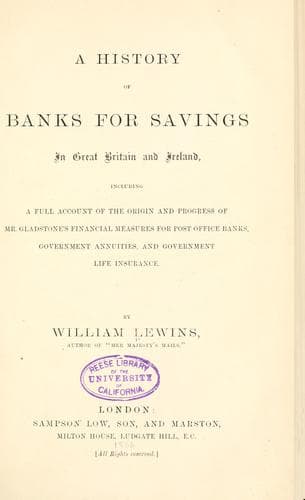
A History of Banks for Savings in Great Britain and IrelandLewins, William
History
A History of Banks for Savings in Great Britain and Ireland
Lewins, William
Postal savings banks -- Great Britain; Savings banks -- Great Britain
Reverting to the consideration of the actual Post Office Bank rate, it
is perhaps unlikely that the small tradesmen class--except where such
persons lodge their money at the Post Office merely for
security--feels satisfied with it. Happily, however, this is a class
which does not need to be considered, and which scarcely will be
considered. The Government offers no factitious allurements or
inducements to any class of the population; and if it did, would be
certain to confine the inducements to those portions of the poorer
classes who stand most in need of encouragement. And as for the rest,
the Post Office Banks do not in any way interfere, as Mr. Gladstone
has recently said, "with the labouring man's liberty of choice, or the
liberty of choice enjoyed by anybody else; if he thinks he can do
better with his money than by carrying it to the Government Savings
Bank, by all means let him do better with it." A low rate of interest
is given for the principal deposited; but then that principal is
guarded with uncommon security, and can be moved, added to, or
withdrawn from, with the greatest possible convenience. And these
terms, theoretically and practically, suit the industrious classes,
whoever else they do not suit. Practically they meet the wants and
satisfy the demands of a large section of depositors, or the banks
would not have shown such an extraordinary amount of success. Nor are
we in want of authorities who assumed, theoretically, that this would
be so. "If Government give security," said a shrewd witness before the
Savings Bank Committee of 1858, "they should pay less interest, on the
principle that Chubb's locks cost more than the ordinary ones."
Dr. Chalmers took great interest, as our readers must already know, in
Savings Banks. His argument was, that the ready receipt and payment of
small sums together with safe custody was everything, and the rate of
interest quite unimportant; he more than once said, that "the result
of high interest had been to swamp our Savings Banks as a national
system." This question of interest was largely discussed in Mr.
Slaney's Committee of 1850. In that Committee Mr. John Stuart Mill was
asked whether perfect security or a high rate of profit was most
sought after by the industrious classes; to which he replied: "In the
case of the working classes no doubt security is the main object, and
it is so in the case of all whose savings are small." In the same
Committee, Mr. J. M. Ludlow, an eminent barrister, gave it as his
opinion that "the poorer a man is, the more important to him is the
safety of his investment, independently of the question of profits;"
and in answer to a similar question addressed to him, the secretary of
a working man's building society said, that "the certainty of security
is the most powerful inducement to investments among the working
population."
Public-domain text, read in full here on John Shaqi.
Reviews
Reviews
No reviews yet
Be the first to share your thoughts on this work.
Elsewhere in the archive
Join the Discussion
Join the discussion
Sign in to leave a comment or review.
Sign InorCreate an account